
Five Day Lightweight Backpacking Meal Plan

Here is a complete 5-day backpacking meal plan similar to what I eat on my hikes. It includes three meals and four snacks, providing 3,500 calories from 2 lbs of food per day.
3,500 calories a day is a good baseline calorie goal for most backpacking trips. I eat this amount on hikes up to 500 miles. After that my metabolism kicks into high gear and I have to eat more (as much as 5,000 calories a day) to keep my energy up and stave off weight loss. The easiest way to add an extra 1,000 calories to this plan is to double up on the snacks.
Packaged, processed foods are a staple of my backpacking diet because they are calorie-dense, non-perishable and available everywhere – but some of them are not very nutritious. To get a more balanced diet it’s a good idea to eat lots of whole foods (meat, fruit, veggies, whole grains, etc.) during your town stops and supplement with vitamins.
I hope this gives you some ideas for designing your own backpacking meal plan.
Day 1 (3,474 calories – 32.9 ounces)
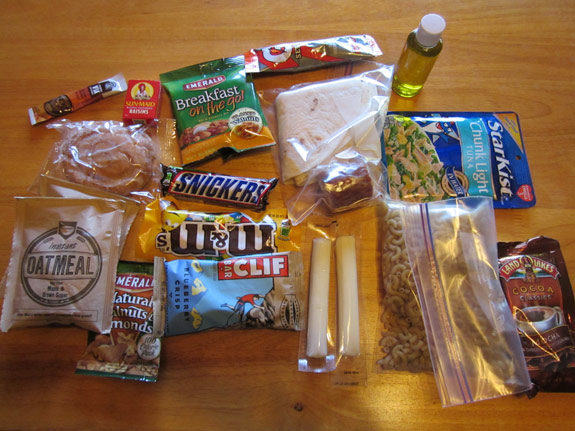
Ultralight Backpacking Meal Plan – Day 1
| Breakfast | Ounces | Calories | Cals/oz. |
| 2 packs Maple & Brown Sugar Oatmeal | 3 | 320 | 107 |
| 1 mini-box Sun Maid Raisins | 0.5 | 45 | 90 |
| 1 100-calorie pack Emerald Walnuts & Almonds | 0.6 | 100 | 167 |
| 1 Little Debbie Honey Bun | 1.8 | 230 | 128 |
| 1 cup Starbucks VIA Instant Coffee | 0.1 | 0 | 0 |
| Subtotal | 6 | 695 | 116 |
| Snack #1 | Ounces | Calories | Cals/oz. |
| 1 pack Emerald Breakfast To Go Trail Mix | 1.5 | 200 | 133 |
| Snack #2 | Ounces | Calories | Cals/oz. |
| 1 bag Peanut M&Ms | 1.7 | 250 | 147 |
| Lunch | Ounces | Calories | Cals/oz. |
| 2 Medium Flour Tortillas | 3.4 | 300 | 88 |
| 2 String Cheese Sticks | 2 | 160 | 80 |
| 2 oz Salami | 2 | 220 | 110 |
| 1 Gatorade G2 Packet | 0.5 | 50 | 100 |
| Subtotal | 7.9 | 730 | 92 |
| Snack #3 | Ounces | Calories | Cals/oz. |
| 1 Snickers Bar | 1.8 | 250 | 139 |
| Snack #4 | Ounces | Calories | Cals/oz. |
| 1 Clif Bar | 2.4 | 230 | 96 |
| Dinner | Ounces | Calories | Cals/oz. |
| 1 box Kraft Macaroni & Cheese | 7.25 | 780 | 108 |
| 1 pouch Starkist Tuna | 2.6 | 80 | 31 |
| 1 tbsp Olive Oil | 0.5 | 119 | 238 |
| 1 pack Land O’ Lakes Cocoa Mix | 1.25 | 140 | 112 |
| Subtotal | 11.6 | 1,119 | 96 |
| Day 1 Summary | Ounces | Calories | Cals/oz. |
| TOTAL | 32.9 | 3,474 | 106 |
Day 2 (3,424 calories – 31.9 ounces)
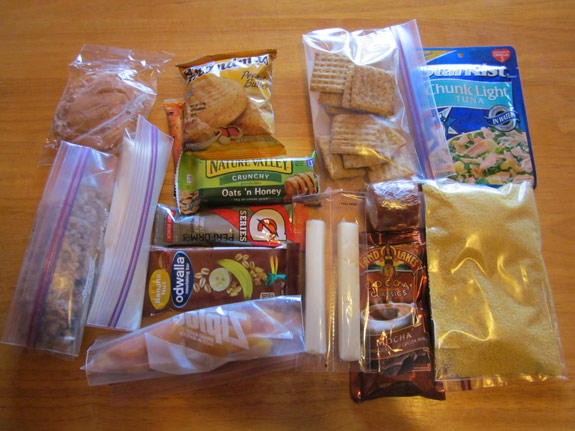
Ultralight Backpacking Meal Plan – Day 2
| Breakfast | Ounces | Calories | Cals/oz. |
| 1 cup Bear Naked Granola | 4.4 | 560 | 127 |
| 1/4 cup Peak Whole Powdered Milk | 1 | 160 | 160 |
| 1 Little Debbie Honey Bun | 1.8 | 230 | 128 |
| 1 cup Starbucks VIA Instant Coffee | 0.1 | 0 | 0 |
| Subtotal | 7.3 | 950 | 130 |
| Snack #1 | Ounces | Calories | Cals/oz. |
| 1 Odwalla Bar | 2 | 210 | 105 |
| Snack #2 | Ounces | Calories | Cals/oz. |
| 2 Nature Valley Granola Bars | 1.5 | 190 | 127 |
| Lunch | Ounces | Calories | Cals/oz. |
| 12 Triscuit Crackers | 2 | 240 | 120 |
| 2 oz Salami | 2 | 220 | 110 |
| 2 String Cheese Sticks | 2 | 160 | 80 |
| 1 Gatorade G2 Packet | 0.5 | 50 | 100 |
| Subtotal | 6.5 | 670 | 103 |
| Snack #3 | Ounces | Calories | Cals/oz. |
| 2 oz Dried Fruit | 2 | 155 | 78 |
| Snack #4 | Ounces | Calories | Cals/oz. |
| 2 Grandma’s Cookies | 2.5 | 340 | 136 |
| Dinner | Ounces | Calories | Cals/oz. |
| 1 box Near East Couscous | 5.7 | 570 | 100 |
| 1 pouch Starkist Tuna | 2.6 | 80 | 31 |
| 1 tbsp Olive Oil | 0.5 | 119 | 238 |
| 1 pack Land O’ Lakes Cocoa Mix | 1.25 | 140 | 112 |
| Subtotal | 10.05 | 909 | 90 |
| Day 2 Summary | Ounces | Calories | Cals/oz. |
| TOTAL | 31.85 | 3,424 | 108 |
Day 3 (3,663 calories – 32.9 ounces)
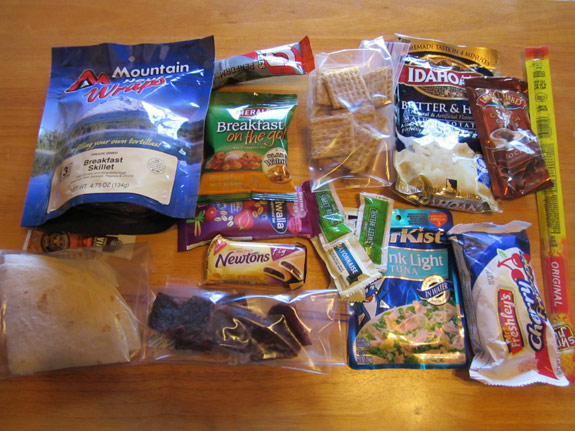
Ultralight Backpacking Meal Plan – Day 3
| Breakfast | Ounces | Calories | Cals/oz. |
| 1 Mountain House Breakfast Skillet | 4.7 | 680 | 145 |
| 2 Medium Flour Tortillas | 3.4 | 300 | 88 |
| 1 cup Starbucks VIA Instant Coffee | 0.1 | 0 | 0 |
| Subtotal | 8.2 | 980 | 120 |
| Snack #1 | Ounces | Calories | Cals/oz. |
| 1 pack Emerald Breakfast To Go Trail Mix | 1.5 | 200 | 133 |
| Snack #2 | Ounces | Calories | Cals/oz. |
| 2 oz Beef Jerkey | 2 | 160 | 80 |
| Lunch | Ounces | Calories | Cals/oz. |
| 12 Triscuit Crackers | 2 | 240 | 120 |
| 1 pouch Starkist Tuna | 2.6 | 80 | 31 |
| 2 Mayonnaise Packets | 0.8 | 165 | 206 |
| 2 Pickle Relish Packets | 0.6 | 24 | 40 |
| 1 Gatorade G2 Packet | 0.5 | 50 | 100 |
| Subtotal | 6.5 | 559 | 86 |
| Snack #3 | Ounces | Calories | Cals/oz. |
| 1 mini-pack Fig Newtons | 2 | 200 | 100 |
| Snack #4 | Ounces | Calories | Cals/oz. |
| 1 Odwalla Bar | 2 | 210 | 105 |
| Dinner | Ounces | Calories | Cals/oz. |
| 1 bag Idahoan Mashed Potatoes | 4 | 440 | 110 |
| 1 Slim Jim | 1 | 150 | 150 |
| 1 tbsp Olive Oil | 0.5 | 119 | 238 |
| 1 pack Land O’ Lakes Cocoa Mix | 1.25 | 140 | 112 |
| 1 Hostess Fruit Pie | 4.5 | 480 | 107 |
| Subtotal | 11.25 | 1,329 | 118 |
| Day 3 Summary | Ounces | Calories | Cals/oz. |
| TOTAL | 32.95 | 3,663 | 111 |
Day 4 (3,254 calories – 31.6 ounces)
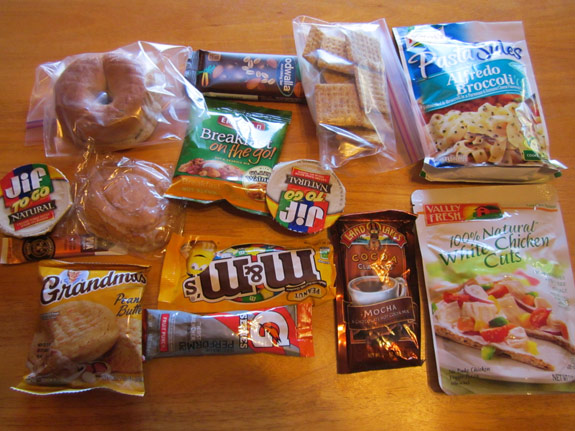
Ultralight Backpacking Meal Plan – Day 4
| Breakfast | Ounces | Calories | Cals/oz. |
| 1 Cinnamon & Raisin Bagel | 3.3 | 250 | 76 |
| 1 Jif To Go Peanut Butter Cup | 1.5 | 250 | 167 |
| 1 Little Debbie Honey Bun | 1.8 | 230 | 128 |
| 1 cup Starbucks VIA Instant Coffee | 0.1 | 0 | 0 |
| Subtotal | 6.7 | 730 | 109 |
| Snack #1 | Ounces | Calories | Cals/oz. |
| 1 bag Peanut M&Ms | 1.7 | 250 | 147 |
| Snack #2 | Ounces | Calories | Cals/oz. |
| 1 Odwalla Bar | 2 | 210 | 105 |
| Lunch | Ounces | Calories | Cals/oz. |
| 12 Triscuit Crackers | 2 | 240 | 120 |
| 1 Jif To Go Peanut Butter Cup | 1.5 | 250 | 167 |
| 1 Gatorade G2 Packet | 0.5 | 50 | 100 |
| Subtotal | 4 | 540 | 135 |
| Snack #3 | Ounces | Calories | Cals/oz. |
| 2 Grandma’s Cookies | 2.5 | 340 | 136 |
| Snack #4 | Ounces | Calories | Cals/oz. |
| 1 pack Emerald Breakfast To Go Trail Mix | 1.5 | 200 | 133 |
| Dinner | Ounces | Calories | Cals/oz. |
| 1 bag Knorr Pasta Alfredo | 4.4 | 480 | 109 |
| 1 pouch Valley Fresh Chicken | 7 | 245 | 35 |
| 1 tbsp Olive Oil | 0.5 | 119 | 238 |
| 1 pack Land O’ Lakes Cocoa Mix | 1.25 | 140 | 112 |
| Subtotal | 13.15 | 984 | 75 |
| Day 4 Summary | Ounces | Calories | Cals/oz. |
| TOTAL | 31.55 | 3,254 | 103 |
Day 5 (3,785 calories – 31.7 ounces)
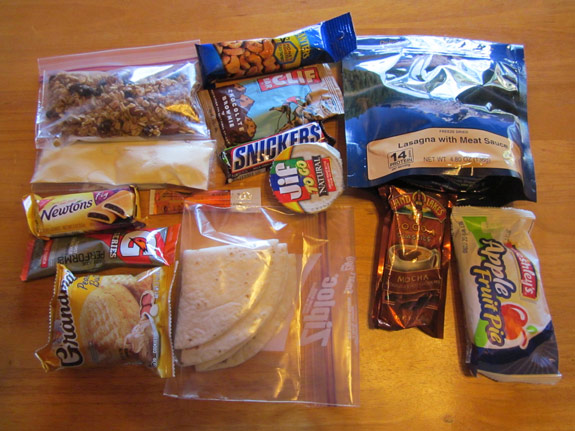
Ultralight Backpacking Meal Plan – Day 5
| Breakfast | Ounces | Calories | Cals/oz. |
| 1 cup Bear Naked Granola | 4.4 | 560 | 127 |
| 1/4 cup Peak Whole Powdered Milk | 1 | 160 | 160 |
| 1 mini-pack Fig Newtons | 2 | 200 | 100 |
| 1 cup Starbucks VIA Instant Coffee | 0.1 | 0 | 0 |
| Subtotal | 7.5 | 920 | 123 |
| Snack #1 | Ounces | Calories | Cals/oz. |
| 1 Clif Bar | 2.4 | 230 | 96 |
| Snack #2 | Ounces | Calories | Cals/oz. |
| 2 Grandma’s Cookies | 2.5 | 340 | 136 |
| Lunch | Ounces | Calories | Cals/oz. |
| 2 Medium Flour Tortillas | 3.4 | 300 | 88 |
| 1 Jif To Go Peanut Butter Cup | 1.5 | 250 | 167 |
| 1 Gatorade G2 Packet | 0.5 | 50 | 100 |
| Subtotal | 5.4< | 600 | 111 |
| Snack #3 | Ounces | Calories | Cals/oz. |
| 1 pack Honey Roasted Cashews | 1.5 | 225 | 150 |
| Snack #4 | Ounces | Calories | Cals/oz. |
| 1 Snickers Bar | 1.8 | 250 | 139 |
| Dinner | Ounces | Calories | Cals/oz. |
| 1 Mountain House Lasagna w/ Meat Sauce | 4.8 | 600 | 125 |
| 1 Hostess Fruit Pie | 4.5 | 480 | 107 |
| 1 pack Land O’ Lakes Cocoa Mix | 1.25 | 140 | 112 |
| Subtotal | 10.55 | 1,220 | 116 |
| Day 5 Summary | Ounces | Calories | Cals/oz. |
| TOTAL | 31.65 | 3,785 | 120 |
 My name is Erik Asorson, aka "Erik the Black." I'm a long-distance backpacker, cartographer and author of
Erik, great resource blog and excellent ideas for light and calorie-rich foods – thank you!
I second re-packaging backpacking freeze dried meals into freezer ziplock bags to save space to fit enough stuff in a bear canister. Freezer bags easily withstand boiling water required for cook-in-a-bag meals – I’ve even re-used some bags multiple times on multiple trips.
I would really like to hear non-cooking alternatives. I don’t like to cook anything on the trail because 1) I am too anxious to get going in the morning, 2) I am too tired at night, and 3) a stove and fuel has a weight penalty.
Hi Erik,
This food list includes a lot of packaging that you will have to carry around for 5 days. Why not buy a “big” bag of Fig Newtons and just take what you want for the trip in a zip lock bag? In fact leave the Junk food fruit pies which will inevitably get crushed and just take Fig Newtons. It’s only 5 days. How about making some home made brownies and wrapping them in a zip lock bag which can be reused ?
Are you serious with those silly little peanut butter containers? How about a small plastic container holding 300 to 400 calories worth of your favorite nut butter. Leave the little plastic dishes in the store they are a waste of plastic. Same for the chocolate drink packets. too much garbage.
Tom: If you are only hiking for five days and then going back home, then you have a lot more options for preparing and packaging food. But long distance backpackers have to string a series of five day food hauls together one after the other, usually with only a day off in-between for shopping, shower, laundry and preparing food for the next stretch. Convenience foods can save a lot of time and sometimes are all that’s available in the small towns near the trails.
Erik… just got back from an 8-day, 93-mile hike of the southern third of Vermont’s Long Trail and wanted to pass along a huge thanks for your meal plan! I’ve done plenty of 2-3 day backpacking trips, but this is the longest distance and time out that I’ve done – and I really had no good idea how to go about planning food for that kind of trip. I initially thought I’d cherry pick ideas from you and others, but ultimately just copied your 5-day plan almost verbatim and extended it to 8-days.
It was a lot to carry at about 17 pounds, but I didn’t want to come off the trail and enjoyed eating down the weight. I loved the variety and some of the simple ideas for more interesting breakfasts and lunches that I probably wouldn’t have thought of. Tuna pouches ruled, and it’s a brilliant thought to carry mayo & relish packs that don’t require refrigeration! Little Debbie Oatmeal cookies were definitely my favorite snack, a throwback to my school lunch box as a kid. Loved also the granola with hydrated powdered milk. And the Mountain House bagged food. I could not find Valley Fresh Chicken pouches so went with Tyson’s version instead… that I could do without, due to heavy aftertaste of … “something”. Won’t be packing that again!
Thanks also for the guidance in the comments – about using the 16-ltr Granite Gear sack as the food bag. When I had all of this food laid out on the counter, I didn’t believe it would all fit. However I packed each day in a gallon zip bag, squeezed out excess air, and incredibly did get all 8-days in that 16-ltr bag! That is, except for four Mountain House meals, which I packed in a separate bag due to their bulk. One tip for others… rather than separate out the tortillas to individual days, I found it worked well to place an entire 8-pack as the top layer before zipping the bag up. Leaving the tortillas flat, stacked together, allowed them to travel well without creasing/tearing that would have resulted from separating into individual days. I would make it a point at the start of each day to pull out that day’s ziplock, adding tortillas each morning as appropriate, and placing at the top of my pack for easy access from the trail. The calories worked just about right for me – while I would have liked to drop a few extra pounds on this trip, I came home about even. I was averaging 12-mile days with quite a bit of elevation gains/losses. This food plan was just right to maintain energy through the day.
One final comment about coffee… I consider real brewed coffee to be a true treat in the backcountry, one that’s worth just a little extra weight and effort. My method is to carry conical filters and pre-measured snack baggies with ground coffee for each day. I use 4-1/2 coffee scoops for an 18-oz brew which only requires the filters and a plastic filter holder that rests on the top of my mug while I pour hot water from a pot. The filter holder does add some bulk in the pack, but only a couple of ounces of weight… enjoy!
So what do you do with the coffee grounds and filter after brewing?
So…how do you pack it LOL!
I am using your ‘how to hike [lots] of miles per day’ with different segments broken with snacks. I am VERY excited about this approach and think it will be a fantastic way to cover miles without feeling like I want to die by the end of the day.
I have an upcoming (my first actually) through hike of 150+ miles and would like to do 5 days before my first resupply. However, I just can NOT fit 5 breakfasts, 5 dinners and 15 snacks into my Ursack (and I have the big one!). I have resigned myself to the fact that I will have to do 2 resupplies but would love to see an article where you show how you fit these 10 lbs. of food into a pack.
Thanks for the site – it has really opened my eyes to a lot of new approaches!
@Jason Hill: I use a Granite Gear Zippsack (16 Liter) for my food bag. I think it has a similar capacity to the large Ursack but it’s a different shape (cubical vs cylindrical.) Sometimes getting 5-6 days of food in there is like putting together a puzzle. Repackage anything that comes in bulky packaging from the store in ziplock baggies and try to eliminate any air pockets and gaps between items. Another thing you can do is choose snacks that are uniformly shaped (like candy bars, granola bars, etc.) They fit together better than items which are irregularly shaped or have lots of air trapped inside the package.
Thanks for this post. I am a registered dietitian and hiker. I had worked out that my daily requirement for an upcoming hike would be around 3500 calories, so this was perfect inspiration for the types of foods I cook take 🙂 I agree – backpacking is not about trying to be perfectly healthy whilst on the trail – its about packing as light as possible and dense calories.
I was looking over your food list, based on what your have. How far ahead of your trip would you purchase the items listed
Donald: There are a couple ways to do it. You can buy food “as you go” where every week or so you go into town and buy food for the next leg of the journey. Or you can buy the non-perishable items first and mail them to yourself and then just buy things like cheese, salami, etc. that don’t have as long of a shelf life as you go.
Thank you Eric. After reading nearly every comment on this page, I would like to repost my very favorite quote from you so that others don’t miss it and I can reference it easily…
“We are biologically programmed to enjoy rich, fatty, starchy, sugary foods because our body knows that they provide the most energy. In the context of a sedentary lifestyle this leads to obesity and disease. In a highly active lifestyle it provides much needed energy that few other foods can match.”
I think this pretty much sums up the whole page in a couple sentences. 🙂
Happy trails.
Man, if you are allergic to nuts like my son is, your backpacking meals are limited.
I’m new to backpacking and a little confused about this whole food thing. 2lbs of food for a 5 day hike is 10lbs. I see people using bear bags and hanging them from trees, but it looks like it’s not all 10lbs in the bag. Where do you store the other 8lbs of food at night? Like the Mountain house food? In your pack because it’s not open yet? How do you keep the smell down?
Thanks!
@Brandon: If you are going to hang food to protect it from bears you should include all of your food with it (and other smelly stuff like toiletries.) Also, it may be wise not to cook at your campsite because lingering smells can attract bears even if you store all of your food in a bear box or hang it afterward. I like to cook at the last rest break of the day and then hike a few more miles before camping.
Erik, Great, thanks! I would have never put my toiletries in the food bag had you not said anything! Thanks for the help and advise, stay safe.
Brandon
If you think toiletries in a bear bag are easy to forget, when I was in Boy Scouts in the 1970s we even had to put our rolls of camera film in the bear bags! If you’re too young to remember the film days, camera film has a very distinctive smell, sort of like a sweet chemical smell. Sure, bears can’t eat film, but the scent was enough to attract them to your camp site where they would then seek out anything else that smelled tasty. Ah, the good old days…
Funny how backpackers with their ultralight gear eat to stay fat and heavy…
@Fred: Not even close. We eat to stave off the rapid weight loss that occurs on a long distance hike. When you are burning 6,000+ calories a day, eating 4,000 calories a day is a drop in the bucket. You also have to pig out in towns on all-you-can-eat buffets, pints of ice cream and everything that isn’t nailed down. And it’s still not enough. Most thru-hikers look like they escaped from a concentration camp after five or six months on the trail, even if they started with an extra 30 lbs of body fat.
Which makes you wonder: why hasn’t anyone come out with an “AT Diet Book” yet? 🙂
toward the end of my Appalachian trail hike I thought nothing of sitting for 3 hours on the curb outside a walmart and eating continuously. I finished my hike at 55 years old and weighed less than when I graduated high school. My food in my pack weighed more than my pack and gear.
I didn’t know of too many fat thru hikers
Thanks for some really useful information Eric! I’ll be putting it to use on the AT soon.
What was your mileage when you did this? I am doing a 4-day, 40-mile thru hike. I do not want to pack too much food. It seems like a lot of calories.
@Nate: I usually do around 20 miles a day. For your 40 mile hike you probably won’t need to eat as much. The hiker hunger doesn’t really kick in big time until after a couple weeks on the trail. I would think that 500 to 1,000 calories per day over what you eat normally would be sufficient.
Thanks a million for the menu example. I’m beginning to gear up for some AT hiking with a friend, and want to stay as light as possible since I’m past 60 and not in top shape. Keeping food weight down is a worry.
VERY helpful. Thanks E!
Erik, I’m not sure what size bear canister to use for a hike on the Tahoe Rim. I’d like to have a five day supply of food. Wendy
@Wendy: If you want to keep all five days of food inside the canister something like the Bearvault BV500 should work. They have a smaller size too, but it’s only slightly lighter and can only fit a few days of food.
Took a lot of your food suggestions on a 5-day pack to Yosemite. The “Little Debbie Sweet Rolls” were tasty. I’ll be bringing them along on my next trip. Thanks
Also brought along a 1 pound Big Agnes camp chair. I’ll never leave home w/o it. Really nice to be able to rest your back.
instead of sitting on the ground,rock or tree stump.
I recently started using some butter sandwiches, smashed flat, then dried. Not sure of calorie density, but actually tastes pretty good, eats easily, which can be nice, not sweet, cheap, and fairly space efficient. Carrying a big pepperoni stick is a good source of food.
Having trouble locating powdered WHOLE milk. All I can find is low or no fat. Any suggestions?
BTW: Love your guide book and your site.
@Mr Clean: Powdered whole milk is usually sold under the brand “Nestle NIDO” in grocery stores (sometimes it is hidden in the Mexican or baby food aisles instead of by the low-fat powdered milk.) The Peak brand (available from Amazon) is also good.
I can almost always find Nido with the Hispanic foods at Walmart. My local grocery store didn’t carry it for many years but is now starting to.
Eric,
my first multi-overnight backpacking trip with my 15 year old daughter as huge success…thanks for the food suggestions.
We both AGREE..Dump Grandma. Her cookies really sucked from our point of view….the rest worked great for us.
We added in a package of canned chicken with each dinner…added some texture and flavor.
Thanks for the post.
Mark
This is exactly what I’ve been looking for! Thank you for making this easy to understand, with pretty visuals! I can’t wait for my next trip so I can plan my meals. Thank you for all the time it took to put this together!
Great information!!! How do you pack items like fruit pies in order to prevent crushing on the trail?
@Rob: They usually get crushed, but they are still good 😉
Erik. You are an animal. Looking at this calorie intake seriously blows my mind… But I understand the necessity of it if you are doing multi-day/week/month hikes like this. It’s just the numbers are seriously staggering.. That being said, thanks for taking the time to put this all together. I am planning a week-long trip through the Uintas for later this season and the information really came in handy for considering my own meal preparation. Will be checking back with your site in the future.
If you want to go really lightweight, you have to go high in fat. I wrote an article here with some very lightweight very delicious meals. https://freshalpineline.com/2016/08/14/10-days-of-delicious-lightweight-food/
Thought you might be interested in a better tasting peanut butter I use and is easier to pack then the Jif round packs. It is called “Justin’s” and is outstanding! I recommend the Honey Peanut Butter pouches but he has several kinds to choose from. I purchase mine from Amazon.com and take 2 per meal with whatever you like with it. Just a suggestion….I enjoy your site and lists I have used many ideas for myself and son.
Thanks,
Tony
@Tony: I’m a big fan of Justins Nut Butters too. Very convenient to pack and lots of flavor varieties. Thanks for mentioning them.
Erik- Thanks for the meal plan. I just had the mac-n-cheese on a 3-day hike to Geraldine Lakes-Spanish Mnt-Crown Valley in the John Muir Wilderness. The pot cozy worked great. I’m planning to introduce your meals to some boy scouts.
How much would you say this 5 day supply of food would cost? What did you carry the olive oil in? Did you mail whole packages of food ahead like this?
@Colorado Kid: This meal plan (as it is laid out exactly here) shows different foods every day. I did this to illustrate the variety of different foods you can eat to achieve the same goal. But, in actual practice I don’t usually include that much variety on a daily basis. It is better to eat some of the same foods over and over again for a single resupply leg, because you can purchase those items in bulk (some items are not available in single servings.) With that in mind, five days of food like this will probably cost you around $50 – $75 if I remember correctly. I carry olive oil in the small 1 ounce bottles like you can find at REI. I try to avoid mailing food and prefer to shop in towns as I go. That way I can make changes to my diet on the fly and the food is fresher. But, in cases where there are no grocery stores to shop at, I will mail non-perishable foods forward from the last big town and then buy perishable foods (like cheese) to supplement with at a convenience store or whatever is available.
Why only a 1oz size bottle for olive oil? I’m imagining resupplying at a grocery store and trying to find their smallest bottle. I’d guess 6-8oz. Do you split that with someone? Or do you bring several 1oz bottles instead of a bigger one? Have you ever had a leak?
Also do you have clever ways of consuming more oil than 1 tbs/day? Since it’s the highest calorie/weight item possible (aside from stove fuel), seems like you could shave a lot of weight if you could find a way to consume more of it in a pleasant way. Or is that a bad idea due to *cough* digestive issues?
Thanks for such great info!
@Marcel: On longer hikes I usually carry more olive oil (like around 4 ounces.) What I have done in the past was just buy a bottle at the store and send it forward in my bounce box, then refill the little bottle in my pack occasionally. You can put olive oil in almost all of your hot meals, it just depends on how much you can tolerate (more than a tbsp at a time can make it kinda oily.) I’ve put it in oatmeal and most of my hot dinners (mac and cheese, rice, noodles, couscous, etc.) to bump up the calories. You could also just shoot it, if you don’t mind the taste.
Eric the Black, this is really great information – thanks for sharing your methodology and the nutritional information.
Erik, I’m confused by the calorie count on some items. The 7.25 oz mac & cheese has a calorie countof 260 on the box, however it shows as 780 calories on your list. The same issue with the box of Couscous – 190 calories on the box, but 570 on your list. What am I missing? Thanks!
@David Stephenson: The box contains several servings. I eat the entire box at once 😉
Erik,
One of the best sites I’ve visited for food ideas – not so inclined to make my backpacking trip experience all about “how gourmet I can go” – Most of what you’ve listed are what I have been using for years, but the layout, caloric intact and weight listings that you have added make this site really nice – love how user friendly you’ve made it. I run faith-based adventure ministry for students (ranging from 12-45 students per trip) so simplicity and ease reign supreme first. kudo’s dude.
Hi Erik,
I wanted to share a discovery that I made about 5 years ago.
http://hawkvittles.com/
Click on Products to see Nutritional info.
I use a cozy and hydrate in his bags or buy the double size and break it into 3 meals using ziplocs. (female hiker) I’ve never had any issues or dishes. I carry a long handled titanium spoon and a .8 liter Jetboil system.
Macadamia nuts are loaded with calories mostly from fat. If you are an athlete watching your carbs and running your body on fat, these are awesome (but expensive).
Erik,
As opposed to a pot cozy, have you tried using a Kleen Kanteen wide mouth insulated cup? This is what we use as it makes for easy clean up. After a meal you basically fill the cup up halfway with water, shake it up and drink your water, no waste. Also, what are your thoughts on Patagonia Tsampa Soups? Also using sunflower seeds and pine nuts as they provide the lots of calories. I tend to buy stuff in bulk (like granola and mountain house meals in a #10 can) and just weigh out portions and compress into Zip lock bags. Can also make awesome oatmeal/nut/fruit/instant milk recipe combinations into zip lock bags. Over a 5-day span, how much weight do you have in used food packaging? Do you save it and dispose later? Or do you burn it up at some point?
Erik, another question on the individually wrapped cheese sticks (i.e. string cheese). you say they last on the trail for up to 5-days. Do you also put them in your resupply caches which could sit somewhere (unrefridgerated) for several weeks?
@Dan: I don’t put things like string cheese or salami in resupply caches because they would spoil. I just buy them at a grocery or convenience store in trail towns.
Hello Erik,
We are starting to prepare for the Colorado Trail and we are wondering do you use an Opsak inside of your Granite Gear Zippsack?
Also, thank you for all the great information!
Chris and Dawn
@Dawn: I don’t use an OPSack. I have tried one before, but it wore a hole in it very quickly. Once that happened I figured it wasn’t any good for containing smells. I do keep most of my food packaged in regular plastic ziploc baggies inside the zippsack though.
This is great. I love the organized layout that you did with the food, it makes everything very easy to understand.
My question is, how do you keep the salami and string cheese from going bad?
@Rachel: Salami and string cheese will last for 5 days in a backpack as long as the weather is not terribly hot.
It looks like mountain house breakfast skillet (4.73 oz) is now closer to 800 calories. Just an FYI. The lasagna remained unchanged in the packaging update. Also, I forgot to say “thank you”. Your advice is invaluable.
Thanks for the great ideas Erik! I have 2 questions about the Gatorade mix with the sawyer mini Ive seen on your other gear posts…1) does the sawyer filter out the taste and 2) does the mix clog the filter quicker?
@William: I’ve never tried putting mixed drinks through a filter, but I think it might clog it up. If I am going to mix drinks I’ll usually carry a separate bottle (like a 1 liter soda bottle) for that. To get filtered water into the bottle you could squeeze it out of the water bladder through the filter (which is kind of a pain) or use chemical drops (like Aquamira or MSR Sweetwater Solution) for mixed drinks (as an added bonus the flavored drink powder covers up the taste of the chemicals.)
Hello Erik. My son is about to hike appx. 50 miles of the AT with his Scout troop. I’d love to know how you prepare the Knorr’s Alfredo noodles. Do you bring powdered milk to use in place of actual milk or do you use some other substitute?
@Stacy: You can use powdered milk, but it’s not necessary. Water will do. I like to add olive oil for extra calories and richness. The trick is getting the amount of water right. The amount they recommend on the package is usually too much (designed for a long simmer) and will end up with runny noodles. Off the top of my head I think the right amount of water is about 12 ounces. Bring the water to a boil, then add noodles, simmer for a minute or two, remove from heat and transfer to a pot cozy and wait about 15 minutes, then stir in some olive oil and should be good to go. One mistake to avoid is putting the noodles in the cold water before boiling. That makes em mushy.
Eric, just wanted to thank you for all the useful info on your blog, and in particular, this post. At 5’1″ and 95lbs with a very fast metabolism, I’m always worried about bringing enough calories/fat/protein with me on trips. Usually I travel by kayak, so weight of gear and food has never been an issue.
I am headed out tomorrow on a 4 night backpacking trip to Cape Scott on Vancouver Island. This post and comments have steered me away from dehydrated meals (briningg 1 breakfast and 1 dinner as backup in case we stay out an extra night) and given me the ok to carry food that I know I will want to eat (Annie’s Mac and cheese, pepperoni, dried fruit, etc…).
Next challenge will be to downsize my gear (tent, bag and pad, which probably weigh a total of 13lbs). Thanks again and keep the posts coming; they are very much appreciated.
Capella161 – With only a 4 day trip, the crazy amount of calories is not such a big issue. Of course, always good to have enough so you don’t “crash”, but it takes a while for your body to start on the caloric defecit that requires the insane intake of high amounts of calories and fat that can be an issue with carrying the amount of food needed to sustain you. We’ve found that anything less than 5-6 days and you can bring whatever you wish/pack/carry. If that is chocolate and junk food, so be it; but it’s less critical. You’d be fine with dehydrated (if that’s what you like), with a few daily snacks of nuts/chocolate. IME, anyway. Oh….and GOOD idea to lighten the load weight! That is HUGE! 🙂
Super helpful information. Thank you.
Hi Erik,
My friend and I will be hiking the JMT this summer. I’ll be using the Scout by Wild Ideas One of the sections will require food for 10 days, which means not all of the food will fit in my bear can. What are your thoughts on using an Ursack for hanging the excess food? Would that be overkill?
Thanks for your help.
@Judy: If you are going to hang the food you probably don’t need the Ursack, assuming you do a good hang and the bears can’t easily get to it. But since there are some sections of the JMT without trees, an Ursack could be useful for those nights where you have extra food but no good trees to hang from. You can also try and schedule your hike so that some of your nights with extra food are spent in campsites which have bear lockers. It’s somewhat of a gamble with food on the JMT since it’s hard to be 100% bear-proof all the time. But every little bit helps.
This season I’m adding powdered coconut milk to my coffee creamer, soup mixes, granola. 175 calories per ounce, very mild taste, found in the Asian food section at most grocery stores, dairy-free/ vegan, thickens and makes everything creamier.
Hello Erik,
First off, I have to say that I have been reading and following your website now for the pat 6 months and I love all the info and tips. I do have a question, what type and how big is the bag you use for your food? I have been reading on your gear links but wasn’t sure if you use the same bag to store your food as the same bag that you use to store your cooking supplies in.
Thank you
@Morgan Watkins: I use a 16 Liter Granite Gear Air Zippsack as a food bag. I like this type of sack better than a stuff sack because the zipper makes it easy to root around inside and get to all your food without having to dump it out first.
Hey Erik,
Just wanted to thank you for creating such a wonderful blog/site! I’ve found a lot of useful information here and will be altering both my trail and emergency food storage as a result.
PS – Have forwarded your url to a friend who is doing the JMT in August.
Hi Eric,
Wow, you are so patient with all our questions! Just want to say thanks for all the great info on food and clothing. It is nice to know that I can get by on store-bought food packets and not have to rely on expensive, “specialty” foods. Yay Hostess Fruit Pies!
Erik,
Getting ready to take 20 boy scouts on a 50 miler. Your site has been tremendous. Any attempts with eggs? If they were premixed and put in a sealed container, how long would they last without refrigeration? Quickly scrambled in the am sounds good. We’ll be in the Yellowstone back country and your recommended 5 day menu looks great.
@Brad: I have not tried fresh eggs on the trail myself. You might want to check out these plastic egg carriers. I don’t know if this is true, but I always assumed that eggs stayed fresh longer if kept in their shells than when put in another container. You can also do dehydrated eggs. The Ova Easy brand actually tastes like real eggs when scrambled up.
I will crack eggs,season and mix thoroughly and freeze in a zip lock bag. Put in a small insulated bag with other chilled foods for my first night and first breakfast on the trip. Works great 🙂
Brad. I’ve put some eggs in a plastic water bottle right before I left for the trail, you shake the bottle and bam scrambled eggs. It was a cold weather trip, under 30°, so the outside temp was better than the fridge lol.
I don’t usually write on blogs but I just wanted to say thanks for all of the amazing tips and advice. I’M getting ready to hike the tahoe rim trail on April 19th and feel much more comfortable about my gear and food selection now. Do you think the trail will be difficult to navigate in the early spring?
@Andrew: Normally the TRT would be covered in snow in the early spring, making navigation more difficult. But, since we are in the midst of a multi-year drought here in California, I’m not sure what conditions will be like this year. It’s possible the TRT might be mostly clear of snow this spring. I would pack a GPS just in case though. It makes navigation in the snow much easier.
Erik, first let me say I LOVE your site and come to it frequently for gear ideas, etc.
You might want to suggest to Richard (March 5th post) that he should see a cardiologist before hitting the trail again. Needing to stop every 50 steps might be, and probably is, simple dehydration, overexertion, etc. But… it also might be something else that requires more immediate attention. Sounds similar to something my dad experienced (ended up w a triple bypass).
Hey Erik- wondering about fuel consumption with pocket rocket. Most of the stuff talks about how long to boil water- but with the mac and cheese, noodles, rice stuff you are cooking longer, right? So if you use a MSR small canister everynight for a dinner, how many days could it go do you think?
Other than that, I’d only boil water for oatmeal in am and don’t drink coffee.
thanks!
@Chris Leahy: What I do is bring water to a boil, add the food, reduce heat and simmer for an extra 1-3 minutes (depending on the food), then turn off the stove and transfer to a pot cozy for ~ 15 mins. I can usually squeeze 5 dinners and 2-3 breakfasts (instant oatmeal and coffee) out of a small 4 oz canister this way.
Hey Erik! I’ve been really enjoying your blog. I always like to see how other backpackers lay out their food plan for more than a day or two. After working off a diet that is very similar to yours I bought a dehydrator a few years ago and a food saver vacuum packer shortly thereafter. It was the best investment I every made to my gear. Creating dehydrated meals ahead of time that are both tasty and have the protein and calories we need has changed the way we eat. You can also boil in the food saver bags without worry of leaching chemicals. Home made jerky is 10 fold better than grocery store bought and experimenting with things like dried chili-pineapple chunks and watermelon chips is always fun! It takes little planning, but completely worth it! For transport we use Opsaks, one for food, one for trash. However the granite gear bag looks like it may be what I try next. The Opsaks get holes in them after tumbling around camp for a week or two. Thanks for all your info!
I’m doing the same thing! My digestion just can’t tolerate all that processed food, even for a few days. I already have a vacuum sealer (great for putting away extra servings, or for a farmer’s market haul) and am researching dehydrators. Of course, I love to cook and bake anyway, so this is just another tool for my obsession! 🙂
I am 62 and will start my thru hike of the A.T. on July 25, 2015 (I am committed until then)in Maine. During my recent 5 day shake down hike I struggled with leg fatigue. The entire five days were rated moderate to strenuous. By day 3 I was taking 50 steps and resting several minutes and did this many, many times during the day. I would eat b’fast once I was on the trail(cold food), snack several times during the a.m., lunch was crackers/cheese/sausage or PBJ on bread and more snacks then a hot dinner. I think it is diet related, so do you think it is more of an issue of lack of protein or lack of carbs??
Richard: It could be related to carrying too much weight, lack of overall physical fitness or diet. As far as diet goes, I think that carbohydrates are more important for hiking than protein. Protein is the building blocks of muscle and other tissue, but carbohydrates provide energy. If you’re running out of gas you are probably not getting enough carbs (and possibly not enough calories overall.) One way you can test this theory is when you start to bonk, eat something like a Snickers bar, which is high in sugars and fats. You could also be dehydrated so make sure you are drinking enough (and getting electrolytes.) If you don’t feel a second wind coming on after that, it might not be your diet. Since you’ve still got a few months before your thru-hike you have time to work on your fitness and finalizing your gear. I would try and walk five miles every day (around town is fine), do day hikes on the weekends with a full pack (10 miles a day), and get your base pack weight (all gear minus food, fuel and consumables) down under 15 lbs. Also, count up all the food you are eating on the trail and make sure you are getting at least 3,500 calories a day. Good luck!
Erik lots of great info for sure and I trying to absorb as much as I can. I am retired and hope to get back on the trail but doing some long distant hikes. My question is I see you pack your food into a Granite Gear Bag but how do you separate the days within the sack or not? Thanks
@George: You can separate your food into days by putting each day in a gallon ziploc bag. Or you could divide it into meal-types (breakfasts, lunches, snacks.) The only downside to doing it that way is it creates un-used space inside the food sack (between the ziploc bags.) If I need to pack a lot of food (like more than 5 days worth), I’ll throw it in loose so it can fill up the gaps better. My eating routine is pretty formulaic, once you know the formula it’s not really necessary to allocate certain items for certain days, you can just mix and match em.
Hi Erik,I am a 2014 AT thru hiker and plan to hike PCT on April 14,2015(already registered) or delay after 28. According to your excellent experience and weather predictions, do you think I shall go on 4/14 or at the end of April enen beginning of May? Do you think any major gears difference between AT and PCT? Do I need to add any more gears? Thanks.
@MJ: Opinions differ on when the best time to start a PCT thru-hike. But I prefer earlier when it is cooler. This will give you more time to go slower in the beginning and get used to the desert conditions (which are a lot different than on the AT.) The reason some hikers leave later is because there is the possibility of reaching the Sierras too soon when the snow hasn’t melted enough yet (the usual recommended Sierra entry date is June 15th.) But I don’t think that will be a problem this year. We’ve had some late-season snowfall here in California, but we’re still in the middle of a drought. I don’t think snow will be a problem, but water will be. Some of the water sources which normally run in the spring in Southern California may be dry, which means longer water carries. I recommend having a water-carrying capacity of at least 8 liters. You won’t need it all the time, but some times of you will. You can find reports of recent water conditions at points along the trail here: PCTWaterReport.com. Direct sunlight is also a big factor in Southern California. I like to carry a reflective umbrella for shade, but you will need at least a floppy sun hat, sunglasses and sunscreen. Some people with fair skin like to wear a long sleeve shirt too. Once you get out of Southern California you’re into the woods and mountains which will look more familiar. There is more water (still not as much as the AT), more greenery and more shade. Here is an example of a Pacific Crest Trail Thru-Hiking Gear List. Happy trails!
For the meats like tuna, they can come in either water or oil. The weights seem to be the same but the “in oil” ones carry more calories and, I imagine, more flavor. You seem to favor the “in water” meats. What is your thinking on “in oil” versus “in water”?
@Stuart Snow: Oil sounds good to me. I thought the tuna that comes in the foil pouches was always in water, but maybe I just overlooked it. If you can get tuna in oil without the can I will definitely try that.
I’m a huge fan of couscous. Comes in different flavors and uses a minimum amount of fuel. As soon as the water boils, you remove it, pour in the couscous, oil and spice bag, and let it sit for 5 minutes: done. I also tested couscous on the trail with no heating; put all the ingredients in the pot, and walked away for about 20 minutes. It is done perfectly, just at ambient temp. A good meal to have along in case you run out of fuel before resupply stops. I grow tired of pouch tuna, so I always add pouch chicken. Not as readily available, but so tasty. Brands are Sweet Sue, Tyson, and Valley Fresh (I can usually find this one at Target groceries, the rest are easy to get online). Hiked the Colorado trail a couple of years back and ate couscous with chicken for 35 days. Never got tired of it.
As a section hiker, I have the advantage every year of looking back at what I packed and deciding what will go again and what won’t. Frankly, I love your list. Lots of variety and great cal/oz ratios as well as weight considerations.
We still cook in Ziploc and swear by it. No muss, no fuss.
As for the “nutritional considerations”, I’m with you. This isn’t they way I eat off the trail, but when you’re slogging 18-25 miles per day the only thing that really matters is calories. Being hungry on the trail is awful and eating bland food is nearly as bad. Another way I look at it is that all this high carb, processed stuff is my treat for the other 51 weeks of the year that I eat well and exercise so I can treat myself to a wonderful walk in the woods for a week. It’s the only time I ever buy Pop Tarts!
Keep up the great blog!
Hey Erik, I first gotta say awesome site. A lot of helpful Information with the pictures and listing calories. I’m planning on doing a thru hike on the pct next year and was wondering if you could tell me how much you would spend on average per week to live off the type of diet you listed above. Also, I don’t know if this out of your range, but do you know the average cost a hiker would spend on food alone for the entire trail. I’m really struggling to comprehend the food situation and figured someone with experience would be able to help me. Thanks in advance.
@Brandan: I don’t keep real close track of what I spend on food, but I believe it’s around $50 – $75 for five days (100 miles worth.) That would equal 50 – 75 cents per mile. At that rate you’d spend $1,300 – $2,000 on trail food to hike 2,650 miles. That doesn’t include eating in restaurants in towns. If you take 20 weeks (5 months) to hike the trail, and stop in town once a week and eat two restaurant meals (one dinner and one breakfast), that would be 40 restaurant meals. Throw in a handful of zero-days will probably add another 10 town-meals. So let’s say 50 restaurant meals at $20 apiece = $1,000. That would be $2,300 – $3,000 for food to thru-hike the entire PCT. Food is going to be your biggest expense (after your gear is all paid for.) If that is too much there are ways to reduce your food costs, by spending less in towns and buying more staple foods in bulk and fewer pre-packaged foods.
I can see Ken’s point. I’m allergic to soy (which is in snickers and pop tarts by the way, I think mac and cheese too), just trying to get into backpacking, and the food choices are super difficult. Soy usually gives me really bad stomach indigestion and issues, so I stay away from it. Unfortunately, soy is in most processed foods. Any tips? or am I just screwed haha.
@Wendy: Here are a few backpacking foods off the top of my head that probably don’t have soy in them: Peanut butter, nuts, seeds, dried fruit, instant oatmeal, instant rice, pasta, couscous, mashed potatoes, beef jerkey, summer sausage, foil-pack tuna. The main criteria to look for is: high calorie-to-weight ratio, taste you can tolerate eating over and over again, non-perishable, low water-content, and in your case soy-free.
Thanks, Erik! I appreciate the suggestions. I’ll put that on my list of items to test out.
Dinner…a bag of mashed potatoes and a slim jim??? Come on man. Thats horrible nutritionally. The amount of processed junk food in this pack is ridiculous.
@Ken: Junk food is what long distance hikers live off of. Occasionally you can find some foods that are nutritious, lightweight, non-perishable and provide enough calories to fuel such a massive energy expenditure – but they are few and far between. Many idealistic eaters have tried to thru-hike while sticking to their “healthy” diets and failed (either because of lack of calories or bland taste.) I remember hearing stories about when Ray Jardine’s book came out and he recommended hikers eat corn pasta because it was supposed to be a nutritious hiking food. Soon after, hiker-boxes on all of the major trails started to fill up with abandoned bags of corn pasta as hikers switched over to Snickers bars, Pop Tarts, Mac & Cheese and all the old junk-food standbys that we know work.
Hi Erik,
I’m getting ready for my JMT trip this summer and I’m trying to decide what cook system I’m going to use that will help me reduce weight. My last trip I cooked out of the pot eating my food out of it. I want to save more fuel. I think this summer I’ll try cooking using a pot/bag cozy method. I heard on the JMT they might ban alcohol stoves so I plan to use a gas canister Jetboil or my Snowpeak.
My question for you is what are the pluses and minuses of cooking in the ziplock bag vs the pot? I heard some foods are hard to cook in the cozy method. What do you think? Which method between bag vs pot do you prefer?
@Theo: For a while I liked cooking in Ziploc bags because of the easy cleanup. But I’ve become worried about chemicals leaching from the plastic into my food, so I’m back to cooking in the pot. As long as you make a point to clean the pot immediately after finishing dinner before the food dries it’s not really that much less convenient. Another benefit of cooking in the pot is you have the opportunity to simmer some foods which may require a bit more cooking than just adding boiling water.
Hey Erik,
I just wanted to say I’ll be thru-hiking the AT trail this year starting March 1st, with 0 experience, and I’ll be solo, So It’s safe to say you and your articles have been an essential part of my preparation. I’m very thankful to have access to all of this information and hope you keep at it. happy trails.
LOVE your posts and lists, and have added them to My (backpacking) Favorites so I can find ’em again! My hubby and I are planning to attempt a thru hike on the AT in 2016 (when I retire), and are getting in as many 4-5 day hikes now as we can. Have been swapping out gear for ultra light, and getting ready to hike one of our favorite spots in a couple weeks: the Porcupine Mts in MI. Our daily food list has a lot of the same items. We use pepperoni in place of salami. Like the spiciness, and it packs well – never had a problem with it in warm weather. Pepperoni and PB on a tortilla – yum! Hubster also likes foil packets of sardines. Good protein. Noticed you also have fig newtons – another of our favorite treats, as they pack well and give just the right amount of sweetness. Thanks again, and keep hikin’!!
Hi Erik,
I’m new to backpacking, and am planning my first 4 day hike near Reds Meadow, CA. Your website and guidebooks have been invaluable for my research and preparation. I’ve been practicing cooking on my little camp stove on my patio all this week. I even set up my tent in the yard several times. My neighbors think I’m nuts.
Thank you for making this info so accessable for us newbies!
Erik,
Was looking over your post while planning for my next hike and was curious as to how you calculated your caloric requirements. My understanding is that basal metabolism + (200 kCal per mile) would be the correct way to determine caloric requirements – but it doesn’t seem you did this.
How did you figure your requirements and how many miles would you expect to hike on 3.5 kCal a day?
@Mike: That equation sounds about right to me. My base metabolic rate is about 2,500 calories and I like to hike around 20 miles a day, so I would I burn around 6,500 calories per day. But, to carry that much food (assuming 100 calories per ounce) would require 4 lbs of food per day, or 20 pounds per 5-day stretch between resupplies, which I think is excessive and possibly counterproductive (carrying that much extra weight will burn even more calories.). I prefer to carry less food (between 2-3 lbs a day) and plan to lose weight over the course of a long hike. When I hiked the Pacific Crest Trail I lost 35 pounds over the course of five months. This seems to be the approach that most thru-hikers take. One way to try and stem the tide of weight loss is to pig out during weekly town stops to hedge against the caloric deficit on the trail.
Hi. i was wondering what type of salami you buy when you go hiking. How long does it last? max temp on the hiking trip I’m going on is 75 degrees
@Brandon Y: I buy Italian Dry Salami (usually the Gallo brand which is available in most grocery stores). You can buy it pre-sliced or buy an entire tube and slice off chunks as you go (the second way stays fresh longer.) I pack Salami for up to five days with no problems. I have heard that Salami can be stored at room temperature for a month or more, but I’ve never tried keeping it for that long.
@erik I noticed you carry string cheese. This will stay fresh for five days? IVe also noticed some people carry babybell cheese that comes in the wax coating. What im worried about is the cheese going bad and having one less item for lunch.
@Orlando: String cheese will last for five days no problem. It helps that mozzarella is a low-moisture cheese and they are individually wrapped. I’ve carried lots of cheeses on the trail and never really had any totally spoil before to the point where I wouldn’t eat it, but in warmer weather they do sometimes get a little greasy and gooey and less appetizing. In cool weather cheese works great.
Erik – This post is great! I’m putting together a trip through the Wind River Mountains with some friends who don’t backpack much and I referred them here to get some ideas and learn the basics. Thanks so much!
I’m getting ready for a 7 day backpack and have been freaking out because even though my bear can is packed with food the calorie count is only averaging 1500 per day. Luckily I found your list! With some simple adjustments I should be able to get myself squared away. Thanks so much for sharing this Erik!!
Erik, I’ve been trying to figure out ultralight breakfasts. I was surprised when I saw your list included hot breakfast items. I thought for sure ultralighters just ate cold breakfast bars to get an earlier start. I know when I cook breakfast on the trail it takes me an extra 30 minutes or more boiling water, setting up and breaking down my kitchen, washing dishes and packing it all up. What’s your thoughts on it?
@Theo: Hot breakfast cereals are usually lighter weight and provide more calories than cold breakfasts and they don’t take too much extra time if you do it strategically. As soon as I wake up I put a flame under the stove, it takes about five minutes for the water to boil. Meanwhile I am getting dressed. When the water reaches a boil I pour a cup of hot water into my mug for coffee, add the cereal to the water left in the pot, remove the pot from the heat and put it in a pot cozy to warm up for 10-15 mins. I use this time to break camp, pack up and go to the bathroom. By the time breakfast is ready I am dressed, packed and ready to hit the trail. Then all I have to do is eat, rinse out my pot and go.
Thanks a lot for the detailed meal plans. We’ve used some of your ideas in the past and are using them again since we’re planning a Boundary Waters canoe trip in August. We can carry a little more weight on this trip but still want to keep the weight down for portaging.
Thanks for the info! My brother is allergic to nuts, fish, and beans so his options for trail food are quite limited! I have been searching the web to get some ideas and found some helpful info in your post! If you have any other suggestions for someone with such allergies, they would be greatly appreciated! Also, how do you cook the chicken that you paired with the Alfredo? I bought a pack of Tyson chicken pieces that came in a similar package and do all my cooking by boiling water. My pot isn’t big enough to submerge the package in the water and I’m not too sure what the best way to cook it would be. If you could let me know your thoughts I would really appreciate it! I’m leaving for a trip in a couple days so I doubt I’ll hear from you by then but I do look forward to a response! Thanks for the ideas!
@KC: Since the chicken in the foil packs is already cooked I add it to the hot food in the pot after it’s done, give it a quick stir and put the lid back on for a few minutes to warm up the chicken.
Great stuff, thank you! I competed in two desert stage racing events, each 7 days, approx 155 miles: the first event I used dried freeze food and gels — by day three, I couldn’t stomach it any more. Second race, I changed my food to ramen noodles, betty crocker instant mashed potatoes, steak jerky, pepperoni sticks, chocolate honey stingers, and jelly belly sports beans (and NUUN for electrolytes).
Next race, I’ll definitely be incorporating many of your items and ideas. Thanks for the breakdown too, extremely helpful.
Erik – I have a question on how you carry/store your olive oil during backpacking trips. What type of container do you use. Olive oil seems to leak out of everything. Thanks!
@Richard: I pack olive oil in these little flip-top bottles from REI and then put that inside a ziploc just to be safe.
Thanks! Another good reason to go to REI!
Erik I have found your articles more than valuable. I am just starting out and the amount of info is overwhelming. My question is do you carry 5 days worth of water with you also or do you find water along the way? I know water is the heaviest thing to carry.
@John: I find water along the way from creeks, springs, campground faucets, etc. Depending on how much water is available I’ll typically carry between 1 – 4 liters at a time (in rare instances in the driest deserts I may carry as much as 6 liters for stretches where water sources are more than 20 miles apart.) I usually try to drink 1 liter of water for every 5-8 miles in cool weather and 1 liter for every 3-5 miles in hot weather.
You’re the man for putting this together. So many great mix & match ideas as well.
Cheers,
Dave
G2 packets vs. Emergen-C
All great ideas! At the very beginning, you mention supplementing these meals with vitamins. To expand on that, I might swap out the Gatorade (G2) packets with Emergen-C. Compared to G2, Emergen-c has approx. equal amounts of carbs and calories + way more potassium and vitamins. Emergen-C has less sodium than G2, but given all the processed/packaged foods built into these meals (i.e., lots of salt!), this shouldn’t be a problem.
All that said, maybe I’m missing something else valuable about G2 packets…?
Thanks for the great info! I’m trying to put together meals for my Boy Scouts for backpacking. Do you have a cost/oz or cost/calorie per day? I’m looking at what is least expensive for backpacking comparing what you have done vs. MRE’s, Mountainhouse (too expensive to use exclusively), and dehydrated meals in food storage canisters. Any recommendations would be greatly appreciated. Thanks!
@Steve: I don’t track my food costs that closely, but when I go to the grocery store to buy food for a five-day resupply it usually comes out to around $50 – $60. I think on a calorie vs. cost basis the most expensive items would be the snacks. You can put together a 1,000 calorie dinner for a couple bucks pretty easily, but snacks like energy bars, granola bars, beef jerky and pre-packaged trail mixes may cost several dollars for just a couple hundred calories. If you buy in bulk and make things like trail mix yourself you can bring the cost down substantially over buying the pre-packaged, single-serving stuff. I make a simple trail mix from mixed nuts, M&Ms and Goldfish Crackers that costs just a buck a serving and each serving is 400 calories.
This is fantastic! Thank you so much for providing not only a list, but a very intricate one at that. I’m very excited to develop my own from your guidelines! Thanks again!!
Hi Eric,
1.Do you have a detail shopping list for this 5 day meal plan? I am planning no mail drop on AT thru hike.
2. I am from Asia,58, 140lb,5’5″,do you think 3500-4000 calory per day will be enough for me to do thru hike? I try to control My bag weight to 25lb including base,food and water. Can you suggest some oriental food also light weight and have high calories?
@MJ: A real-world shop-as-you-go shopping list would be slightly different than shown here. For this article I tried to show a wide variety of different foods you can eat on a long hike in order to get the calories you need. But if you are not planning any mail drops your menu may be a bit more repetitive. Some of the items you will buy will come in packages of several servings (for example oatmeal comes in boxes of 10-12 packets). So if you buy a box of oatmeal, you are probably going to eat oatmeal every morning for breakfast for the next five days. But then you can do something different for the next stretch. As far as Asian foods go, Instant Ramen Noodles are a popular lightweight staple for thru-hikers. It’s cheap, high calorie and can even be eaten uncooked if you run out of fuel.
Any suggestions on the best way to prepare the boxed Kraft Mac and Cheese that calls for butter and milk? or is there a mix that only requires water?
@Bradley: I like to use powdered milk and olive oil, but it’s not necessary. You can make macaroni cheese using only water and the cheese powder.
Here is how I make it:
1) Boil 2 cups water (less than what is recommended on the box directions)
2) Add the entire box of noodles
3) Let boil for 2-3 minutes
4) Remove from heat and drain excess water (so there is just a few tablespoons remaining – enough to reconstitute cheese)
5) Add cheese packet and optional ingredients (1 tbsp powdered milk, 1 tbsp olive oil, salt & pepper, hot sauce, tuna, etc.) and stir
6) Transfer to pot cozy and let sit 10 mins
Thanks Erik, I figured it was something along those lines, I’ll give it a trial run here at home before I hit the trails.
Love your site, lots of great info here! Keep up the good work!!
Another option on the mac and cheese I found recently is using the Velveta brand. The cheese is already “constituted” which is going to add a few ounces, but easy to prepare. Boil noodles. Dump cheese in. Either way, mac and cheese on the trail is a delicacy! Enjoy!
Cheesticks? I’m sure you have answered this somewhere on your blog but I just found you through pinterest.
What brand of cheesesticks do you buy? How long do they last? I will be hiking/backpacking for around 5 days on the AT in March. I have never done it before (my hubby is making me do it Ha!). Just getting some ideas. We’ve been preparing since September.
@Yolanda: I buy the individually wrapped cheese sticks from the grocery store (no particular brand – whatever is available.) Most stores have mozzarella, cheddar, monterey jack and colby varieties. The mozzarella (string cheese) packs best due to it’s low moisture content. The other cheeses tend to get a bit oily in warm weather, but they are still fine to eat. They will last 3-5 days.
I was just wondering how much this food would cost?
@Jake: Off the top of my head, I guess I usually spend $50-$75 per resupply for about five days of food.
I always love your ideas! I’m just curious as to what condition those fruit pies are in by the time you eat them? I love those, but never packed them because I assumed they’d get squished into goo after being packed…
@Michael: Yeah, the fruit pies are pretty much exploded by the time I eat them 😉 But they still taste as good.
Thanks for all these ideas. It is much more than I would eat on a trek, but it is a good idea for more variation in the food-plan. But you are right: The breakfast (made out of muesli) changed after some days to cereal bars.
Have to say I’m not a fan of this list. It’s very high in carbs, saturated fat, and sugar and not very light. I guess it would be okay on a 5 day trip, but on a thru-hike, it seems like you’d be more sluggish than necessary and have more issues with muscle and joint inflammation.
@WA: Carbs, fat and sugar are the best foods for long distance backpacking. Most thru-hikers eat a diet similar to mine. A small minority attempt to maintain a health-food diet on the trail, and some actually do it. But most fail because they can’t get enough calories to keep pace with the massive energy needs of a long hike (backpacking burns more than 600 calories per hour) and the food becomes so monotonous and bland that it kills their morale and the will to continue. I have seen many a hiker transform from Health-food Evangelist to Junk-food Junkie mid-hike (myself included), once the reality of rapid weight loss and energy deficits begin to sink in.
Your assessment that my diet would be good for a five day trip, but not good for a long hike is backwards. On a five day trip it doesn’t matter what you eat. Your body will burn stored body fat to make up for any deficits. Once the fat is all gone, and you are burning 6,000+ calories a day for months on end, then you need to crank up the calories to avoid starvation. And there is no better way to do that than by eating carbs, fats and sugar. We are biologically programmed to enjoy rich, fatty, starchy, sugary foods because our body knows that they provide the most energy. In the context of a sedentary lifestyle this leads to obesity and disease. In a highly active lifestyle it provides much needed energy that few other foods can match.
Unfortunately many of the packaged foods I eat on the trail also contain chemical additives and non-foods, like: artificial flavors, colorings, sweeteners, trans fats, msg, preservatives, etc. This is a compromise I’m willing to make because it is what’s available in grocery stores and markets near the trails. I prefer not to buy bulk food in advance and prepare, dehydrate it and ship it to myself because it is too inconvenient. You can make your meals healthier by using whole ingredients instead, and eliminating the artificial additives. But the diet should still be based around carbs, fats and sugar. These are the three pillars of a long distance hiking diet.
If you like coffee but not instant, you can also take beans with you and crush them up with a rock or pummel with the butt of your knife inside a piece of cheesecloth tied with a thin string and dip it in.
Also, I recently found Pack It Gourmet meals and they taste great and easy to prep.
I like your plan. But it appears to have a bit too many sugars and carbs for my diet. I am trying to sway towards more fats and less sugars.
I found you through Pinterest.Thank you so much for your light backpacking meals. I love how you’ve laid everything out. I am going on my first trip in three weeks and this will help a lottt! Thanks again!
Erik,
Thanks for the plan/ideas. I’m pretty sure this tasty 5 day play would easily fit into a BV500. Please keep up the great work.
Another post full of great ideas!! Since I have a tendency to lose my appetite at the beginning of any hike, it also lightens up my load. It’s taken about a year, but I have finally put together a decent diet for the trail that won’t annoy my colitis issues. packs well, and gives me variety throughout the week.
NIDO can still be found in Walmart in the Hispanic food section in most of the stores I have been in. We keep a large can of it on hand for emergency use, period. My food system usually consists of my rodent proof bag made by Ursack and an OP bag inside to contain odors. I don’t carry a bear can either unless it’s mandatory. Since I am smaller and female, it works for me.
Erik,
I use the Granite Gear sack to carry my food but have a super hard time fitting all that food into my bear canister. I find myself taking chances by hanging what won’t fit in the canister. What bear canister do you use? I’m doing the TRT in a few weeks…
@Patrick: I have the same problem with bear canisters. I never carry one except when it is mandatory. I have a Bearvault 500. It’s too small for a normal resupply, but if I pick foods specifically because they are low-volume and flexible, re-pack it in ziplocs and squeeze it in there (so that very little air space is left between items) it can fit barely.
Hi Eric,
I am enjoying your blog alot. We are just starting out with backpacking. I am wondering if there are calorie recommendations for kids? I pack and hike with my daughters. The girls are teens (15 &13). We are hiking roughly 7 miles a day at a comfortable pace. Is there a way to calculate their calorie needs for hiking?Before your recommendations we were carrying alot! I am gradually re-gearing us for lighter loads. The girls typically carry their “big three”, their own clothes, survival gear and a days worth of water. (current weight total 20#). I however carry the rest of the water and food for all of us as well as my packed gear. (42# this last trip!). So we are overdue to lighten our loads…Thanks!
@Tuckersrunner: I expect that teenage girls would require fewer calories per day but I’m not sure exactly how much less. You could probably figure it out by using a Basal Metabolic Rate Calculator to figure out how many calories they would theoretically burn at rest based on height, weight, age, sex and then an Exercise Calorie Counter to figure out how many more calories they would need per hour of backpacking. That should put you somewhere in the ballpark.
Erik,
Great food ideas. I recently completed the Colorado Trail. I did the oatmeal thing everyday. I also have used Seasoned Rye Krisps for crackers for many years of trips. They are good fiber, and very resistant to breakage. I package 6 of the individual crackers in a zip lock for lunches. For dinners I did the Couscous and chicken pouches most of time. I can get chicken in a pouch at my local Super Target, which has groceries. I dessert idea for consideration. I put 1/2 box of instant pudding in a zip lock bag, then add powdered milk that will reconstitute to 1 cup milk. Mix the two powders together in the same bag, and then add 1 cup water, mix in the bag, let stand for about 5 minutes and pudding magic! The bag is the bowl. You can find powdered whole milk at many Hispanic groceries (unlike the fat free at our gringo stores!). Last comment; I had your map atlas for the CT; outstanding resource. Everyone who saw it and didn’t have it, wanted my copy!
@Bill K: Thanks for the pudding idea. That sounds delicious. I used to have much more luck finding Nestle NIDO at stores but it really seems to have dried up in the last few years, so now I just buy the Peak whole milk online from Amazon. I can’t stand non-fat powdered milk. We don’t have any Hispanic grocery stores in the small town where I live, but that’s a good tip for people in bigger cities.
are the mountain house dinners the usual 2 man dinners?
@William: I believe the Mountain House Dinners do include “2 servings” per bag, but I treat it like one serving.
Have you tried the Mt. House ProPak ? They are portions much larger than a “single” portion (but not quite as much as a 2-serving package), and better, they are vacuum packed so that there is not nearly the bulk of unaltered factory packaging ! Can’t find these everywhere but my local outdoor activity store has included some of these in their order when they know what I want. Try it !
Hi Eric,
I really like your meal plan for both convenience and taste. It is almost exactly what I would enjoy except that I would eat the fruit pies at the earliest chance! I love ’em. I have to figure how to save them for a reward towards the end of the day. I appreciate all of your experience and hope to meet you on the trail some day. Thanks, Joe
Erik,
Thanks for all the info. I literally just came back from food shopping for my JMT trip and got your post notification! Where do you buy your Valley Fresh chicken packs? I’ve been keeping an eye out for those but haven’t seen any at my local stores.
@JoT: I get the Valley Fresh Chicken Pouches at Vons supermarkets here in California. Unfortunately they are not as common as the tuna pouches. You can also buy them in bulk from Amazon if you want to stock up.
That’s great luck! I’m in SoCal and there’s a Vons by my work. I just don’t normally go there. Will check it out. Thanks a bunch.
A great source for everything individual, to build these great menus without having to buy boxes of stuff…try minimus.biz for everything from single serving condiments, coffee packets, peanut butters and jams to MRE style Bridgford sandwiches, chicken and tuna pouches, and if you wanna pull out all the stops… black box caviar and lobster pate in 2 oz cans and the fancy crackers to go with. Now if we could only find dehydrated spirits to top it all off.
It’s the same stuff that goes in military Fast Strike rations, SAR rations, Fire Crew (smoke jumper) rations, etc.
Hi Erik. Do you repackage any of the food that you buy in the stores in Ziploc bags? Especially those freeze dried dinners. A lot of times I have to use a bear canister and always have to deal with trying to fit everything inside.
P.S. I used your JMT Atlas in 2011. It served me well, especially over some of the passes because of all the snow the previous winter it was hard to stay on track. Keep up the great work!
@Matt: I do re-pack most of my dinners in ziplocs to save space. Something else you can try with the freeze dried dinners is to open them up first and squeeze out all the air inside (which accounts for a lot of their bulk).
If you purchase the Mountain House Pro Pak, the extra air is sucked out and it makes the package a lot smaller. I have used them for years section hiking the AT. They are a little smaller than the ones full of air, but just as good.
You can also put a pin hole in the bag, squeeze the air out and then put a small piece of tape over the hole.
You can also use a needle to poke a hole in the prepackaged meal to remove the air, then cover the hole with a piece of tape to keep the moisture out.
Any pictures of all this packed up? How big is your food bag for this 5 day food list?
@Nick K: I use a Granite Gear Air Zippsack (Medium 16 L) for a food bag. It holds 5-7 days of food and weighs about 2 ounces. The zipper opening makes it easy to root around inside and find stuff without having to dump everything out.
@Team Walsworth
Will this 5-7 day supply of food fit into a bear container, like those used in the Teton back country?
@Gary: I haven’t has much luck squeezing it all into one of the “7-day” bear canisters (like the Bearvault BV500.) Usually I can get around 4 days in there and have to carry an extra day or two in a stuff sack. I think the bear canister manufacturers have a different idea of what one day of hiking food looks like than I do. You could probably fit it in by reducing the bulkier foods, packing more of the low volume flexible items and eliminating any unnecessary packaging. I find that the problem with getting food into a bear canister is just a much to do with the unused space between the food as the food itself. Getting it all to fit is sort of like doing a jigsaw puzzle.
Excellent list..
This is a little heavier than what I carry because it’s less dense. But it offers a much wider variety and wayyyyy better nutrition than I’m used to. Thanks for posting. This is full of good ideas.
Hi Eric, love your blog. My question is do the pictures show the food “as packed” or do you repackage beyond what is shown? I have wondered about the value of repackaging and the possibility of ziplock failure versus original sealed packaging.
@Tom: This stuff is the way I would pack it. If something comes in a big bulky package (like macaroni and cheese in a cardboard box) I like to repackage it into ziploc baggies, but if something already comes in a lightweight flexible package I’ll leave it.
Nice mix. I now have more ideas on how to
even pack the food I will take. Just starting out in hiking and trying to keep the weight down. Thanks for all your lists, has given me many ideas.
Doug
Hi Eric, I’ve enjoyed receiving all of your information over the last couple of years. The food list are very useful. I’ve saved all of the info and updates that you’ve sent me and plan on using them as soon as I can. A couple of years ago I came down with osteoarthritis of my hip and need a hip replacement. My hiking days came to an abrupt end very quickly. I’m 62 years young and would love to get back to my old life. Do you know of any one that has had a successful hip replacement and is back on the trail hiking? I’d like to connect with them to find out how to do this in a way that is safe.
@Ron: When I has hiking the Pacific Crest Trail I met a man a few miles outside of Cascade Locks who had recently had both hips replaced. He was on his last day of hiking the entire Oregon section of the trail. He hiked at a slow pace (about 1.5 miles an hour) and relied on his two hiking poles a lot to take some weight off his legs, but he was still in good spirits at the end of a 400+ mile hike. When we reached the trailhead he even gave us a ride into Portland. Unfortunately I did not get his contact info so I don’t know how to get a hold of him. But I do know it is possible. Good luck!
Erik, Thanks for the site and updates. Friends and I plan to start section hiking the PCT. Having the time to through hike isn’t possible, so section hiking is our perfect solution. We’re avid hikers, medical professionals and love the outdoors. Most importantly our significant others, for the most part, tolerate our passion. Any advise to section hikers doing the PCT?
Lastly, thanks for the sale on your products; perfect timing for this adventure–just purchased the set.
Ron-
My Father in law had both of his hips replaced and is a new man. He is about the same age as you and can now ride horseback and gets around much easier with very little pain. You will be back on the trail happy again in no time. Good luck!
J
Ron, I backpack with a group of guys that are retired, range in age from late 50s to 74. One of our more dedicated guys, 73, has an artificial hip. He holds his own with all comers on the trail. I will try to get him to check in with you. If not, just be encouraged that there is nothing to stop you !
Hello Ron…I wanted to respond to your message as I have had a hip replacement 6 years ago. I waited and waited to have it done as I didn’t want to go under the knife. I was limping badly and hiking was completely out of the question. After the surgery and rehap, I couldn’t believe how good I felt! I wished I had done it sooner. 6 months after the surgery I hiked up to the top of Freel Peak (Tahoe area) at age 55. If your in reasonably good shape, you should bounce back quickly. All the doctors that I’ve talked to encouraged me to keep on hiking…Trust me, if you find a good orthopedic surgeon, you will not regret it. If you need a recommendation, I can do that as well…Just email me…Good luck
Thanks to all that have responded as it has given me encouragement to go through with my hip replacement knowing that I should be able to hike again.
Ron verify your options before proceeding ie typical small diameter low friction vs large ball designs. Also the folks at http://www.surfacehippy.info have tons of info and encouraging stories. May not apply if you arent a good candidate for a resurfacing but worth a look before deciding on a thr. If you do have to go full thr, there are many many athletes back to running marathons, trail running, rock climbing etc on full replacements. Not a guarantee but the potential is certainly there. Prehab hard, rehab harder and you’ll wonder why you didn’t do it earlier. Also check out the ebook by Alistair McAlpine here http://hiprunner.com/?author=12
Ex ultra runner who had to have a thr and is back to trail running. Hope this helps. Good luck.
My son needs a hip replacement also. I would very much appreciate your recommendation of an orthopedic surgeon. He has seen Dr. Fowley in Truckee already. Is this the doctor you used?
Ron I had a hip replacement 8 weeks ago. Last week I rode 21 miles on my bike (a 10 and an 11 mile ride) I have walked many 4 mile walks an a 5 mile walk. I readying myself to get back to backpacking but I see no hindrances or have no reservations.
I realize ’tis an old post, but wanted to encourage you. I had a hip replacement 11 years ago at age 46. I did not hike before that, but just started last summer. I am planning my second trip to the CT this summer!
Very helpful list. Like the variety while still getting the calories. Question? Could you get this in a bear container? I actually need to go 6 days, but was thinking fewer calories.
@Gary: You probably won’t be able to fit all this into a bear canister. It’s just a little too bulky. The bear canister manufacturers advertise that you can carry five to seven days of food, but I think they are thinking about carrying fewer calories or really low volume foods. One thing that helps when packing a bear canister is to pack everything loose so it can kind of work it’s way into the cracks and use up as much space as possible and eliminate air gaps between the food. I usually carry an extra bag of food for the first few days and just try to camp in places that have a bear box or hang it or just try and pick a place that seems like it would be less likely to have bear problems.
Hi, I am a 64 year old who had full hip replacement just under two years ago and retired two mints ago. Doing the pct this year and feel great!
I am 65, have had both knees and a hip replacement. My brother has had both knees replaced. Last May we completed the rim to rim to rim at the grand canyon. Planning to do the Tonto trail this year.