
Tips To Minimize Foot Pain While Hiking

#1: Carry Lightweight Backpacking Gear
This is the most obvious suggestion, but also the most important. Every step you take sends a tiny jolt through your feet that is magnified by the weight of your backpack and all your gear. Over the course of a long backpacking trip this can lead to big-time foot pain and injuries like: blisters, shin splints, heel spurs and plantar fasciitis. Reducing your gear weight means less impact on your feet and less foot pain.
Articles About Lightweight Backpacking Gear:
The “Big 3” Backpacking Gear Items
5 Heavyweight Backpacking Gear Items You Can Replace With Ultralight Alternatives
Top 5 Backpacks For Thru-hiking and Multi-day Hikes
How To Pack A Lightweight Backpack
#2: Wear Lightweight, Breathable Shoes (That Fit)
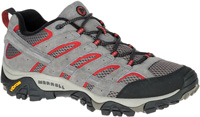
The best shoes for lightweight backpacking are trail-runners, cross-trainers and lightweight boots. When choosing a hiking shoe look for one that is lightweight, breathable, flexible and (most importantly) fits your foot. Traditional heavy leather boots are not good footwear because they are stiff and abrasive to the feet. Buy your shoes one size larger than you would normally wear to make room for foot swelling, which can happen on longer hikes.
Popular Lightweight Hiking Shoes & Boots:
- Merrell Moab Ventilator / Moab XCR (what I wear)
- Vasque Velocity
- The North Face Hedgehog 3
- Salomon XA Pro 3D Ultra 2
- Salomon Synapse Mid
#3: Wear Socks That Provide Enough Cushion (But Not So Thick They Overheat Your Feet)
When choosing hiking socks you want a combination of cushion and breathability. Too thin and they won’t provide enough protection from abrasion and impact against your shoes. Too thick and your feet will sweat like a sauna. Most backpackers I know wear lightweight hiking socks or running socks made from merino wool (and sometimes synthetic materials like nylon, Coolmax or blends).
Popular Lightweight Hiking Socks:
- Smartwool PHD Running Lite Mini Sock (my sock of choice most times)
- Wrightsock Coolmesh Quarter Sock (I wear these in hot weather)
- Wigwam Cool-lite Hiker Pro Quarter Sock
- Smartwool Light Hiker Sock
- Thorlo Coolmax Light Hiker Sock
#4: Replace The Cheap Insoles That Come With Your Hiking Shoes With High Quality Insoles
Unfortunately, most hiking shoes come with cheap foam insoles. They don’t provide enough arch support or shock absorption and usually end up flat as a pancake within a few hundred miles. So you’ll need to cough up another $35 or so for some high quality replacements. The good news is that aftermarket insoles typically outlast the shoes they go in, so when you replace your shoes after 800 miles you can keep on using the insoles.
Popular Hiking Insoles:
#5: Take Frequent Rest Breaks, Remove Your Shoes And Elevate Your Feet
When hiking in hot weather, uneven terrain, or over long distances your feet will probably tend to swell and throb some. This happens when blood flows to your feet in response to the microscopic injuries that occur every time you slam them into the ground. To counteract this effect I like to take frequent “shoes off, feet up” rest breaks.
Example:
2.5 miles (15 minute feet break)
2.5 miles (45 minute morning snack break)
2.5 miles (15 minute feet break)
2.5 miles (1.5 hour lunch break)
2.5 miles (15 minute feet break)
2.5 miles (45 minute afternoon snack break)
2.5 miles (15 minute feet break)
2.5 miles (dinner and camp)
I remove my shoes and socks, elevate my feet and rest them on my pack at every break. This gives them a chance to air out and for the blood to drain back into my legs and relieve any swelling. Plus it feels really good 🙂
#6: Clean Your Feet Often (And Dunk Them In Cold Creeks Whenever Possible)
Nothing in the world feels better on swollen, achy feet than getting dunked in a nice cold creek! The flowing water massages your tootsies, increases circulation, numbs the pain, reduces inflammation and makes everything feel good for a little while.
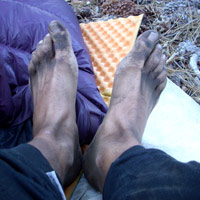
My dirty dogs
As an added benefit, it cleans off the abrasive grime (dirt + sweat) that tends to accumulate on your feet as an unfortunate side-effect of wearing breathable shoes with lots of mesh panels.
Too bad there is not always a good creek available. But it’s still a good idea to clean your feet frequently. When there is no convenient water source nearby I use a moistened bandana to wipe off the grime.
Keeping your feet clean and smooth and free of gunk goes a long way toward preventing hot spots and blisters because it eliminates a big source of friction between your feet and socks (dirt).
#7: Be Proactive About Fixing “Hot Spots” (Before They Develop Into Blisters)
If you follow the first six suggestions in this list: carry lightweight gear, wear good shoes, socks and insoles, take frequent rest breaks and keep your feet clean you will have eliminated most of the sources of friction that cause blisters. But sometimes they are unavoidable, and that’s when you need the “McGuyver” of hiking remedies: duct tape.
There are commercial blister bandages (like moleskin, second skin, etc.) but none of them work as well as duct tape. The beauty of duct tape is that it’s slippery on the outside and super-sticky on the inside. Apply it to a hot spot on your foot and it will stick for a long time, even with sweaty feet, while the slick outside surface glides smoothly against whatever your foot was rubbing on (reducing friction).
The key is to apply duct tape as soon as you start feeling that tell-tale tingle of a hot spot. DO NOT put it off until your next planned break. Stop, drop and tape immediately.
Despite your best efforts you may still develop a blister. Here is the best way I know to fix them: Wait until you get to camp (don’t mess with it while you still got walking to do). Run a threaded, sterilized needle through one end of the blister and out the other side, leaving the thread in place overnight. As you sleep the goop will leach out along the thread, slowly draining the blister, and in the morning it will resemble a flat, dry, hard callous.
Seal the ex-blister with Liquid Bandage and duct tape or band-aid over it. If possible, identify and eliminate the source of friction that caused the blister in the first place, so it doesn’t cause any further aggravation.
LAST RESORT: Take Ibuprofin (“Vitamin I”)
Finally, if nothing else works, you can always turn to drugs. “Vitamin I” is the pet name given to ibuprofin by hikers (because it is such a commonly used anti-inflammatory and anti-pain medicine on the trail). Drugs do not eliminate the source of the discomfort, but they can provide temporary relief by numbing the pain until you can find and fix the real problem.
Have a question about fixing foot pain, or a suggestion from your own experience? Please post your comments below…
 My name is Erik Asorson, aka "Erik the Black." I'm a long-distance backpacker, cartographer and author of
Great information here! I am very new to hiking so thought I’d start by buying a new pair of hiking boots rather than using just running shoes. I borrowed quite a few from the store (oboz, keen, Solomon) walking around my house and finally decided I’d keep the pair of Solomon X ultra 3 mid. They were super comfy around the house and they fit great, but when I took them outside on my first “walk” the arches of my feet were insanely sore after only about 20 minutes. Just wondering if this is normal, as a foot that is not used to boots like this toughen up and a shoe gets broken in. Worried I may have bought a shoe with too high of an arch… or wondering if it typically gets better? Thanks for any advice!
Great tips, thanks for sharing this up here. If you’ve got foot issues like overpronation and supination then hiking can cause you more pain than it should, so being weary of that is a must. The shoes you wear will of course be hiking ones but ensuring they are designed to support your foot condition as well is significant.
Hello
I have a lot of difficulty finding boots to fit and have unresolved foot pain. One thing is I noticed that my big toe tends to ache and the bottom of the toe next to it rubs. I tend to fit for my bigger foot and wonder if the problem is caused by the shoe being too big on the other foot?
A method of blister prevention when a hot spot or blister develops is to cover the area using a small portion of a Telfa pad held in place over the area with Leukotape P medical tape. If I’m treating a hot spot I trim the Telfa pad to a circular size a little larger than the area (for me often the heel area due to narrow feet and heels) and place it on the Leukotape and then center this covering over the area affected. Make sure you push down all edges of the tape and carefully place your socks back on so as not to grab an edge of the tape. You can use the tape alone as a preventative for blisters. That works best for me on the heel and sometimes on the balls of my feet. For a blister, I use an alcohol pad to sterilize the area and a needle. Puncture the blister near the bottom on a vertical surface such as the heel or to the rear if on the bottom of my foot then cover as described above. I find the pressure applied keeps the blister from filling again and the Telfa pad absorbs what drains. I change this dressing at least once usually the following day and dress the area as described until the skin heals. Hiking in boots, leather or otherwise, can be a comfortable experience provided you break them and your feet (Achilles area especially) in prior to long hikes with weight on your back. The key to success in blister prevention, particularly when wearing footwear that does not breath well, is to change your socks often, use a two layer sock arrangement with a thin inner and thicker outer that helps with fit and any rubbing, and the use of a foot powder, possibly medicated as needed. Some of the new “glide” products mentioned in this forum might be good substitutes for the use of powder. Powder should be reapplied at each sock change. I rotate three pairs and change at least 3 times a day in a 15 mile day. Erik’s recommendation of frequent rests and periodic removal of your boots/shoes to help dry everything out is a very wise choice. My experience comes from almost 29 years in the Marine Corps and an awful lot of miles on my feet wearing boots and carrying I’ll fitting, heavily laden packs. I wear trail runners now when trail conditions and season of the year allow me to do so. Semper Fi!
Preparing to do the Camino de Santiago in October and have purchased the new Artyrex water proof hiking boots. they are feelings really great, however, I am concerned when I read that the waterproof styles may not be as breathable.
I’m a day hiker. I had a great pair of hiking boots years ago that finally just fell apart after a lot of use. Then I didn’t hike for a long time. I just started getting back into shorter hikes, working up to 3 to 4 miles. I was wearing tennis shoes and getting a bad blister on 4th toe of my right foot. So I bought hiking boots again. Very uncomfortable and stiff. I used to wear hiking boots because my ankles aren’t the greatest. But with technology, I guess hiking shoes have come a long way and now the thought is to wear hiking shoes because boots don’t really support the ankle. So I went out and got Oboz hiking shoes, after trying several pair at the local mountaineer store. They seemed the most comfortable.
But as soon as I hit the trail, back of shoe was rubbing back against the achilles area. I soldiered on. Around the 2nd mile (and heading back), it started happening on my left foot. And the toe where the blister started forming with the tennis shoes was throbbing. After researching, seems like my feet maybe sit too deep into the shoe. So I pulled out the insole and replaced it with my custom molded inserts that I have and have not liked inside the tennis shoe. It felt a bit better on my next hike. Before going, I covered the bad areas with moleskin. The shoe was still rubbing against the back of my right achilles area. But I thought it was just the pressure of where it was rubbed from before. I got 3 miles out and back again and it was bad, even covered with moleskin. I honestly have no idea what to do because every shoe I tried was already uncomfortable in the store. The ones I bought seemed comfortable. And I really would like to have the lightness of a shoe rather than a boot, as well as have the ankle mobility and freedom that the shoe affords. But the shoes seem to be rubbing the back of my ankle. At the store I was fit and measured and my shoe size is/was accurate as well.
@Nancy: It sounds like your heel is lifting out of or moving around in the heel of the shoe which is causing friction and blisters. This can be a problem low top shoes that don’t fit well in he heel area. You can try to take up the gap with a thicker sock, or you may want to try a flexible mid-height hiking shoe like the Merrel Moab Ventilator Mid. They are made of the same lightweight, breathable, flexible materials as low-top hiking shoes, but they are shaped like a boot which provides more ankle protection and support, and the area where the shoe anchors to your foot is around the ankle instead of the heel, which can make them more forgiving than some low tops.
All the suggestions are useful and can help someone in different conditions while hiking. When it comes to feet protection while hiking, many of the hikers just think about quality shoes and socks. Undoubtedly good shoes protect from outer hassles but are failed to prevent blisters.
Trampers Friend hikers wool is a complete solution for blister-free feet while hiking. Just wrap the hikers wool around your toes and pressure points before putting your socks and boots. This will help to reduce the friction which ultimately prevents the formation of blisters hence making you comfortable all the way in hiking.
I am 56 years old and I am also been prepping for a long distance Camino Frances home in Sept. I have walked over 4000 miles over the last 18 months on trails and at work to build up for it. I have solved various for issues with darn tough socks, and my Keene hiking boots has solved the toe issues. My question is once a week I have been walking 17 miles straight no.stopping for anything, just walking down a trail. My feet are killing me after about 13 miles, but feel fine the next day. Different shoes have made no diffetence. Ibuprofen does make a huge difference. I have new custom orthotics I had made last week and they felt great, but still after about 13 miles my feet start to hurt. Before I go invest in a new pair of shoes like trail runners is the simple answer that.walking straight with no breaks what the neck do you expect and following a break routine should make a huge difference. I hadn’t tried it already because my time has been so tight and I kept thinking my feet will get in shape for it.
@Dave: I think it’s normal for your feet to start hurting after 13 miles straight. Mine usually start to hurt after about 5-10 miles and I have to stop and take a break. It helps if you take off shoes and socks and elevate your feet so the blood can drain out of them. If there is a cool stream nearby to soak them in that’s even better. A certain amount of foot pain is normal on a long hike. I used to think that once I got used to it and my feet toughened up it would go away, but it never did for me. In fact, the more I hike, the more beat up my feat become, and the more aches and pains I have now. You could see a podiatrist and see if there is anything specifically wrong with your feet that is causing the pain. But if your feet are healthy and you are wearing shoes and socks that are comfortable for the first 5 miles, then it is most likely just repetitive stress from taking all those steps. Try adding some strategic shoes-off breaks to your hiking routine and see if that helps. Good luck.
Have you ever used Armaskin sock liners.? Apparently you don’t get blisters if worn under walking socks.
Wow. Lots of great advice here. I am a 55 yr female and have been months practicing for a hike around Mount Blanc in 5 weeks time. My favourite Keen Gypsum mid boots (I have fat feet and Merrells, while comfy and supportive, seem to wear out quickly for me) seemed too worn so I bought an exact copy. Pity I didn’t read all this first as they are waterproof and even wearing new comfy woolen socks, my feet sweat badly. Anyway, I have a 10kg pack and the second wearing of my boots (14km, 500m climb all up) gave me nearly debilitating pain under the outer side of one foot, about the middle and towards the heel. Feels like a bruise. Can it be a fault in the shoe or is it more likely I stupidly did too much too soon in them? Should I replace the insole or be more sensible about wearing them in? Sorry this is so long.
@Kris Nash: In my opinion, the insoles that come in all hiking shoes (even the expensive ones) are junk. I would replace them with a pair of good insoles (like Superfeet, Montrail Enduro Soles or Spencos) and see if that helps.
I have a specific foot pain when hiking. It is the pad of the foot. Just one to two inches from the toes and on the bottom. The rest of my foot is fine and no blisters. It seems to occur when I am on rocky, larger pebble/rocks. I am assuming that better padding may help here and will try an insert but can anyone confirm if it may be something else? I wear merrels and switch to a generic boot once the pain begins and that mitigates it for a while but then it comes back…..please help!
@Rachell: I had similar issues when I first started backpacking. For me it was a combination of not enough padding and also my walking technique. I would clomp around and let the full brunt of my weight fall onto my feet with every step. When I started to make a conscious effort to walk more deliberately and fluidly it went away. That’s something you might want to look at. I think also my feet just weren’t very tough in the beginning and it took a while for them to get used to all that walking. Thicker socks and cushier insoles can be a big help in the beginning. Good luck.
Hi Erik,
I have had a couple issues as well when it came to backpacking, but not like an actual “hike,” but more like walking long distances home. And I actually do take breaks in between. I’ll walk 1 place first to eat and then after I eat, I’ll walk more until I get to my next destination which is usually a coffee shop that’s about 20 mins from my house.
So anyways, about walking technique: What I have noticed that has helped me is Posture. I’ve noticed that when I stand up straight, it makes my feet feel lighter esp. when carrying a backpack whereas if I’m not standing up straight, that’s when the problems arise. And then I keep trying to remind myself: “Stand up straight, stand up straight,” etc…
You are describing pain from Morton’s Neuroma. I would see a podiatrist and/or google utube etc and get tips on eliminating the nerve pain.
Definitely sounds like Morton’s neuroma to me as well. I kept getting mis- diagnosed with plantar fasciitis but I knew because my pain wasn’t in the morning, only after I was on my feet, it wasn’t that.
You can get insoles that will go just behind that pad that is behind the toes. Basically your lateral arch has dropped and the joints of the foot are bashing into the ground and getting inflamed after several miles. Try to find one of these insoles that have a support for the lateral arch and from there get custom orthotics. It was night and day, the relief, for me.
Your hiking schedule for 20 miles in 10 hours requires that you move at 3.47 mph while on your feet. This is a fast but reasonable pace on flat ground but no one keeps this up on steep hills like on much of the AT. Can you clarify your hiking/resting schedule? Even those doing an FKT aren’t moving that fast much of the time while on their feet.
@Mike: You’re right, that does sounds pretty ambitious. I wrote this article a long time ago, but looking back on it I don’t think I properly calculated the time for the rest breaks in the total. I usually hike between 2 – 3.5 mph from 6am – 8pm. That is 14 total hours, subtract four hours of rest and that leaves ten hours of actual hiking. So to do 20 miles in day would require an average pace of 2 mph, 30 miles at 3 mph, etc. (or rest less/hike longer.) I’ve updated the post to get rid of that part. Thanks for the heads up.
Hi – good article!! Hope you can give some advice. I’m relatively new to hiking and seem to get pain on my 3 outside toes, especially on my right foot after about 3miles. It feels like bruising between the toes pad and the foot. If I scrunch my toes in my boot, the pain goes for a bit but then comes back. I’ve tried plenty of boots (Merrel, Salamon (about 3 pairs), TNF, Meindl) and it seems to happen on all of them, so I’m thinking my feet are the issue and not the boots / shoes. I’ve also tried innersoles, but I guess I need to find the ‘right’ innersoles – any advice?
Thanks…
@Simon: Here are a few things to look at:
1) Make sure you have a lot of room in the toe-box of your shoes. A lot of hikers wear wide shoes or shoes that a size larger than normal because you feet can swell during hikes. If your toes are getting cramped up in the toebox that could affect the circulation, cause them to rub against each other, or cause them to rub against the inside of the shoe. Conversely, if your shoes are too big, that can cause your feet to slip and bang around inside your shoe, so that is not good either. You can also adjust the roominess of your shoes somewhat by adjusting the tightness of your laces.
2) Sometimes the toes can rub against each other causing bruising or blisters between them. You can isolate your toes from each other by wrapping them in gauze, moleskin, duct tape or trying “toe socks” like those made by Injinji.
3) Since you are new to hiking it could be that your feet have not had enough time to “toughen up” yet. A lot of new hikers get foot pain because your feet are just not used to all of that abuse. But (assuming there aren’t any other glaring problems in your footwear) your feet should adapt as time goes on.
I’m a newbie at hiking – having a terrible time finding a boot. Toes go numb. Tried different boots – wondering if a hiking shoe would be better as I’m just starting. Doing a Grand Canton hike 10mi decent and assent, 2 days of hiking/camping at bottom. I know feet/shoes most important – really want to enjoy this trip. Light packs this trip, going first part of May!
@Kellie: Yes, hiking shoes are much more comfortable than boots, especially right out of the box. Boots require a long time to break in, but that can feel more like the boots breaking in your feet than the other way around 😉 Check out the Merrel Moab Ventilators. These are one of the most popular hiking shoes. They are available in low and mid-heights and provide more protection than trail runners, without the stiffness of boots.
Hi wonder if you can help.
I have terrible trouble with my feet on long hikes, I get lots of blisters, aching feet all over but mainly heels & balls of feet, my toenails get very sore and go purple ( recently lost a nail)
I’ve done two major hikes first one I put problems down to the accent & decent so decided maybe boots were too small, I’m a size 3 boots are a compact size 5 hi-tec
Second hike I wore completely unsuitable boots and paid the price so I went and had my feet professionally measured etc and bought a pair of Solomon quest prime boots in a size 4 they felt great in shop and room for toes to breath not hitting the tops in anyway BUT I did a tester 10 easy hike to break them in and again I’ve a bruised big toenail
I didn’t feel any rubbing at all so not sure what’s going on.
I’ve small feet a little wide but not a lot of meat on them, could it be more impact related?
@Caroline: You may want to try switching from boots to softer shoes like trail-runners or cross-training/hiking shoes. Boots are stiff and heavy and they can really beat the heck out of your feet. Also make sure that your total pack weight is under 35 lbs.
Erik,hoping maybe you have a thought on this. Breaking in a new pair of Lowas for an Everest trek this spring. Boots feel super comfortable but after my first 9miles on completely flat terrain (I live in Florida!) my longest toe (next to my big toe) are both bruised. now I bought the boots a full size up and I definitely wasn’t hitting the front of the shoe. I’m at a loss if it was perhaps just the new mileage or if there’s some other problem I haven’t considered and should return the boots. Any insights? Much appreciated!
@Tracy: How is the width in the toebox? If it’s too narrow it could be squishing your toes together so they are rubbing against each other. If it’s too wide your foot might be slipping around too much inside. Maybe try a pair of those Injinji Toe Socks? That would isolate your toes from each other so you can tell if it’s toe-on-toe crime or if it’s the shoes that are beating up your toes.
What do you know about “Darn Tough” socks?
It seems they would meet your standards,
Nick
@Nick: I wear Darn Tough wool socks in my boots in the winter. They are great socks. Never had a pair wear out yet. I don’t know if they make any socks that are light enough for hiking, but if they do I’m sure they are top quality.
Erik– leaving on Sept 1 as a new (58 year old) hiker to hike The Camino Way in Spain. I already have callouses on my feet that are beginning to crack (Georgia heat?)
So my question is: get rid of (sand down) the callouses or try to continue to toughen up my feet?
@Karen: The callouses might be a symptom of a deeper problem (like bad fitting footwear or too much pack weight.) I think I would investigate that first to try and figure out what is causing them (assuming they only showed up since you started hiking?)
Hello Erik!,
First off, your insight on all things backpacking has been a fantastic resource for me over the last few years.
I finally wore out my old clunker hiking boots, so I sprang for new pair of much lighter shoes – Ultra Fastpack Mid GTX. Even as a mid they’re over a pound less than my old pair – amazing! Getting to the point… I’m considering replacing the factory insoles, something I’ve never done in the past.
I see that you prefer the Montrail Enduro. Did you do the heat molding, or let them shape on the trail? If the former, do you consider it important?
Thanks in advance!
@Miles: I didn’t do the heat molding with the enduro soles, just let them shape on the trail, which seemed to work just as well.
Hi, Erik! I’ve searched the comments on your site but so far am not finding the answer to this: What do you personally do for stream crossings? Merrill’s & SmartWool’s on, or off? Barefoot, or extra sandals? Waterproof bag over feet/socks/shoes?
Thanks You, Sir 🙂
@Dambara: I just walk across creeks with shoes and socks on and keep going. You could take your socks off, but I do believe in leaving shoes on, because they offer better traction and there can be sharp sticks, slippery rocks and all sorts of nasty surprises on the creek bottom to poke you in the foot. Oh, I do unhook the chest and waist belt and loosen the shoulder straps on my backpack before going in. If you happen to get swept away in the current you will want to be able to shrug off your backpack in a hurry.
Thanks, Erik!
Excellent blog post. You are so correct about cold water! Dunking your legs in cold water after some time is one of the most refreshing feelings in the world.
Awesome tips Erik – love the blister solutions
I could have won an olympic medal for my blisters. I got massive blisters every time I hikes. I went through 6 pairs of shoes and many remedies…nothing solved the problem. UNTIL I found HIKE GOO. I hiked Scotland coast to coast May of 2014 without one blister. 210 miles 13 days and not one blister. HIKE GOO works.
I wear merrell moab boots. They are the rigt size. They feel good when I put them on. But after a long day my feet hurt really bad. They dont hurt when wearing sneakers or sandals. Just the boots. Its not noe pain, heel pain. Just a general pain. In south florida. Really hot. Wear the boots when hiking shorelines while fishing. Keep my feet dry in the mud. Give me traction on steep banks. Any ideas? New insoles?
@Mark: I had the same problem when I first started wearing Merrells. One of the major weaknesses of the Moabs is the thin insoles they come with combined with a very stiff midsole. I would try some high quality aftermarket insoles like Superfeet, Montrails or Spencos. That made all the difference for me.
I will definately try this. The pain is weird. Like I’ve been on my feet for days when it’s only hours. Thank you
I have been “training” for a 430 mile hike on El Camino in Spain. I broke in a new pair of waterproof Merrell boots but every time I wore them with a variety of hiking socks, I got a wickedly bad rash that lasted for days. I have finally deduced that it may be the reduced breathability due to the waterproofing. Does anybody have any ideas on spray waterproofing on non-waterproof boots with regard to breathability? I am thinking about going back to my old Solomon boots which are non-waterproof and low hikers. But I won’t have a very heavy pack. By the way, I am a small, 65-year-old woman.
@Barbara: If it were me I’d go for the old non-waterproof Solomons if they are comfortable for you. I think most waterproof footwear is overrated. Even if it works at keeping the rain out (which most don’t) they end up trapping the moisture from your foot inside, which can overheat your feet, soak your socks, cause rashes, blisters, etc. Waterproof sprays can prevent rain from penetrating the area where it is sprayed on, but water can still seep in at the seams and around the tongue. I prefer breathable non-waterproof shoes combined with wool socks. They are comfy when it’s not raining, when it is raining the wool keeps your feet warm despite being wet, and when the rain stops breathable hiking shoes should dry out pretty quickly.
There is a pill, iconazole, taken once a week for 3-6 months that cures athlete’s foot 90%.
Bleeding painful cracks between toes is probably fungal.
Hi Erik, I am getting ready to hit the AT in a couple weeks. I have been hiking all fall and in December invested in a new pair of Vasque 2.2 Breeze gtx boots that I love. However in the last couple weeks, I noticed “stuff” between my toes, went to the doctor, and was told it is possibly athlete’s feet that could get worse if not taken care of. Through examination, we discovered the back pads of 4 toes had bloody cracks across the bottoms where there is a crevice right above the rest of the foot. The doctor recommended vinegar soaks and a prescribed ointment applied thinly twice a day. And he said not to cover the area. It’s been a long 3 days of sitting around but I need to get this cleared up. He practically recommended everything you described about breaks, etc when I start hiking again. Long story short: What do I do if these cracks aren’t healed in 2 weeks when my flight leaves? Obviously I have to wear shoes and socks, but I don’t want to make it worse. It isn’t outrageous looking now. You’d never know I had anything until you looked on the bottom of my feet and pried my toes apart to see anything. I have a size 10 1/2 left foot and a 10 right foot and these new boots are 11’s.. I am sure hoping at this stage of the game that my feet haven’t grown more and these boots are too small. But the doctor mentioned about giving my toes enough room to breathe better. Any thoughts? Thanks so much. P.S. I am female and looking for comfortable men’s boots in the next size up for me has not been easy at all.
@Thea: In the summertime I wear sandals most of the time (when I’m not hiking) and get deep painful cracks in the soles of my feet. I’ve found that Bag Balm does wonders. What I do is apply bag balm generously to the area 2-3 times a day and wear a nice cushy pair of socks over it all the time (even to bed) to keep the moisture in. It usually takes 3-7 days before the cracks start to heal and the pain goes away completely. It’s a little different from your doctors recommendations, but if all else fails it’s worth a shot. Good luck.
Hi,
I’ve suffered from athlete’s foot for years and have been through creams and dry-sprays which just about manage the problem. Then last summer I completed the 800km Camino across Spain and used toe-socks as my liners beneath lightweight running socks and found that the problem disappeared completely. i thought it might have something to do with my twice-daily ritual of wiping my feet down with a dettol solution, and it may have, but when I got home the problem re-appeared. On a whim I tried wearing toe-socks for a week and the athlete’s foot started to clear up again. I now exclusively wear toe-socks, whether it be as liner socks for walking, or just beneath my shoes for work. No more athlete’s foot! 🙂 Good luck.
Thanks Erik!!! You have given me food for thought. I actually just switched up a size in shoes to 14 and went to a wide to accommodate my foot. I’ve always worn a 13 but it seemed like my toes would end up jamming after a hike of 8-12 miles. I actually just lost the big toenail on my right foot after a 12 mile hike a couple of weeks ago. That’s when I switched to 14W. The Moab Ventilator accommodates the toe well now but I get the same bunching under the toes I’ve always gotten. I just got them and I’m wearing them to work trying to break them in before a hike. With my sedentary job as a jeweler, I know I’ll have an issue on the trail. I’m going to see a podiatrist and see if there’s an issue with my foot. I get a painful callous under my 4th toe where the 3rd overlaps the skin. Makes a hard edge I’ve clipped off many times but it would be nice if I could do away with the problem permanently!!!
Thanks again!!!!
Erik, I have a problem with my sock bunching under my toes. Especially on my right. I have tried just about every kind of sock there is including the lightweight merino trail runners and nothing seems to help. Merrell Moab Vent shoe, Montrail Enduro soles, I even tried the toe socks but still get that bunching under the toes at the crease. Drives me CRAZY!!!! Any suggestions?
@Matt: It seems to me that in order for your sock to bunch up like that under your toes it would have to be gradually getting pulled down into your shoe as you walk. If you can keep your sock taught and anchored in the right place around your heel and ankle there shouldn’t be enough loose material to bunch up under the toes. Here are a few ideas off the top of my head that might help:
1) Experiment with different height socks (ankle, quarter and calf-height) to see if one type does a better job of holding the sock in place than others. Look for socks that have a strong elastic band at the top. Maybe even try a smaller size sock.
2) Make sure that your heel is not sliding back and forth inside your shoe. If your heel is slipping around too much it can create a ratcheting effect that will draw your sock down into the shoe with every step. Try cinching your shoe laces tighter. Maybe try another size or model of shoe with a tighter heel area.
3) Make sure you have enough room in your toe box and that your toes are properly extended and not curling up as you walk. If your toes are curling, they could be grabbing the sock material underneath them like claws, and gradually gathering it into that area.
4) As a last resort maybe you could devise some sort of retainer to go over your sock that will hold it in place. Something like a thin elastic ankle support, ace bandage or even a loop of duct tape wrapped around the outside of your sock above the ankle.
Andrew Skurka recommends Sportslick which is similar to Body Glide but it also contains an anti fungal and anti bacteria agent. It’s also cheaper. My longest continual hike has been 600 miles on the AT. I used Sportslick religiously and had zero blisters. I highly endorse the product.
I second the sportslick! Zero blisters, feet don’t smell, and it can be used on any ” sensitive area” that is getting chafed as well.
Erik, I have a big problem with my feet sweating. I just hiked a local trail that is just a little over 5 miles. Had sock liners, smart wools, and the green super feet. I changed my socks halfway through the hike. What else can I do to keep my feet from sweating so much. By the end of the hike I needed to soak my feet in the cooler I left in my truck. My fellow hiker could not believe how wet my sock were.
Please help.
@Cathy: Try Wrightsock Coolmesh Socks (by themselves, not in conjunction with another sock). They are the most breathable socks I have used. You didn’t mention what kind of shoes you were wearing, but a hiking shoe with large mesh panels (like a Merrel Moab Ventilator or Salomon XA Pro) combined with breathable socks like the Wrightsocks will increase the air flow around your feet. You can also try talcum powder, but that doesn’t really address the core problem (it just helps to absorb some of the moisture off your feet.)
I just switched from wright sock liners to fox river coolmax . The fox River liners are much cooler and still keep the blisters and hot spots at bay.
Cathy, you might also try soaking your feet in tea ala Dr. Oz’s recommendation. There’s a website that talks about it here: http://www.superfoodsrx.com/nutrition/ask-the-doctor/cure-sweaty-feet.html
Erik, I too would like to put out a warning about Ibuprofin. Under doctor’s advice I have taken ibupropfin after heavy physical activities. Even while taking only the recommended dosage I have had serious stomach issues and had my sigmoid colon removed. Recent studies suggest it may be from long term use of over the counter anti-inflammatories.
Thank you for your blog,
Hoot
I hiked 41 miles, 3 1/2 days over thanksgiving on the Florida trail. everything was great, all my needs were met, i was comfortable except for blisters on both feet. I use the Montrail Enduro Soles with the Merrell Moab Ventilator inserts. The heel of the insert created a small ridge that rubbed my heels and caused blisters. Any suggestions? Anyone?
Steve
@Steve: A few things you might want to try: Make sure your feet are not slipping around inside your shoe. Blisters are usually caused by abrasion so if your heels were rubbing back and forth against the insert that could cause a blister. If your shoes are too loose you can fill up the extra area with a thicker sock (or multiple socks) or cinch the laces down tighter or maybe you might need a different size or width shoe. Another thing you can look at it is the material on the inside of your sock. A lot of the wool hiker socks have sort of a carpet-like interior lining that is sort of fluffy but also sort of tough on your feet if they aren’t toughened up already. You could try putting something more slippery like a nylon dress sock inside your regular sock and see how that treats the inside of your feet. Finally the Enduro soles might just be too hard on the top (they are more cushy than superfeet but still pretty stiff) or they may be shaped wrong for your foot. I’ve never used this feature myself, but you are supposed to be able to heat the insoles up in the microwave and then walk around in them to get them to conform to your foot. Another thing you might try (if you have enough room in your shoe) is to put a cheap soft insole (like the kind from the drug store) on top of the Montrails. The only major downside of the Merrel Moab shoes that I have found is that they have a stiff sole with not a lot of shock absoption built in so they tend to pound the bottom of your feet a bit until you get the right insole/sock combination. Oh, one more thing. When you are walking pay attention to how you put your foot down. I used to clomp around and it really beat the heck out of the bottom of my feet but then I learned to place my foot down methodically with each step and that helped a lot. Good luck!
what do you recommend to keep your fingers from drying and cracking around the fingernails?
@Peter Norkus: I’ve never had the problem of my fingers drying and cracking personally, but I do get some pretty bad chapped lips while hiking which I use Carmex for. I often see salves designed to fix things like cracked heels and dry skin in the drugstore which I imagine would work well. The waxy type would probably be better suited for hiking than the lotiony type. At least that is what I have found with lip balms.
Hello I recomend shea butter it used to be sold. In drugstores purified it is sold by ponds but does not hold up well in car. So it is rubbed all. Over nails and cuticals I worked out doors and was a hairdressor licensed IT ASLO HELPS WRIST FINGERS AND KNEES STIffiNESS it has been used for centuries in scalp and hair moisterizzzing ethnic hair products. I do not recomend buying off street or at farmers market as it is called womens gold aas famlies have guarded process passsed. From generation to generation will help you I was a med. Tech. So yes this works!
Hi Erik,
I did the first 550 miles of the PCT last year and carried some baby wipes – each night I washed my feet with one and rubbed in some cream (from Norfolk Lavender in the UK). I suspect what cream isn’t very important – the massage and the softening seem to work. I didn’t have any blisters at all. I used Salomon shoes with thin under socks and bridgedale medium hiking socks over them. I had no trouble with feet getting hot.
Thanks for all the articles.
Robin (UK)
I took up running to control my diabetes (so far almost 8 years and no meds) I have found that Body Glide applied before every run has kept my feet blister free. Would that also work for backpacking?
@Gregg: I’ve never tried Body Glide, but it sounds like it would. Anything that reduces friction will help.
I just received my SeaSkinz waterproof socks which will transform my Chaco sandals into cozy dry boots if I encounter any white stuff. At least that’s the plan — no more frozen feet in snow. Source Basspro, mfr danalco.com, wt. med pair 5 oz.
Hydropel is a wonder! I use it on my feet and inner thighs. I now hike rash free and have never had a blister from hiking. Mind you, I do not have the distinct honor of being a through hiker but more of a section hiker.
Great topic!
@Erik
On sandals, yes consider drying. I’m not a through hiker so while I use Vaseline at home I forego it for a week or two on the trail b/c of odor.
I have taken to wearing toe socks on trail for some protection, reduced toe chafing and also for less dryness.
I have weak ankles — they roll on me occasionally — but sandals w/less support haven’t been a problem.
The improvement in comfort with sandals, again, is amazing. Say good-bye and good riddance to blisters.
It sure simplifies fording also. Wet socks? Not a problem. Cools off the doggies real nice.
PS: Thanks for everything you do. Used your Atlas’s on the John Muir and elsewhere on the PCT and LOVE them. We’ve hiked with (and under) non-believers (there are some) and we can’t understand their reluctance to know where the trail goes and where to camp. Why doesn’t everyone want to know those things?
PPS: Anita and I just adopted a section of the PCT north of Kwaaymii Pt. in the Lagunas — give us a (virtual) wave on your way through while enjoying the best PCT section with our compliments.
I recommend “testing” duct tape on your skin before going out in the field. I have had an allergic reaction to it (plus epsom salts).
But I’m a delicate flower. 😉
My podiatrist hooked me up with medical adhesive to use on hot spots and then apply moleskin. I used to have awesome moleskin that stuck on me like white on rice… it was in a roll in a light blue box. (Tossed the box)
Tried dr scholls & numerous others that don’t stay on worth a flip. I also tried something called “Blistop” by Flexitol – don’t waste your time.
I tend to get blisters in the same spots, so proactively, I spray the adhesive, slap on the moleskin & I’m good.
If anyone knows the brand of the awesome moleskin I can’t find, you’d be my hero/ine.
Dunking your feet often in cold water softens the calluses and skin and can contribute to blisters reforming.
Also agree with poster about taking Vit I for every little hurt. I got ulcers from taking so much. Tylenol works fine.
Erik, excellent point about the nylon socks. My husband and I ended our PCT thru hike only 600 miles in due to his severe (debilitating) blisters. I think the problem was that we were using an ultralight hiking philosophy (a la Ray Jardine) with packs that were too heavy. Too much weight, lightweight shoes, and nylon dress socks were a combination that ended our trek.
Thanks for all the suggestions everyone.
@Don Bacon: I’ve never tried hiking long distances in sandals yet but I do wear them a lot when I’m at home and on shorter walks. Do you wear socks with your sandals or go barefoot? Also, do you use bag balm or anything to keep your feet moisturized? One problem I have with sandals is my heels get really dry and cracked.
@RodentWhisperer: I don’t have any experience with Hydropel (anti-friction ointment). Sounds like it might work well for reducing skin-to-skin contact (like toes rubbing together, thigh chafing, etc.). I don’t know how well it would work for skin to sock contact. It seems like the inside of your sock might rub it off your feet like a towel (or maybe not).
Lollygag: Thanks for mentioning nylon dress socks. I’ve been meaning to try them for quite a while. Mainly just because dress socks are so much cheaper than hiking socks 😉 One thing to point out is that those guys carry ultralight packs with a base weight usually of 10 pounds or less, so they don’t need as much cushion from a sock.
Elite distance hikers such as Ray J, Scott W, Eric D use thin mens nylon dress socks. If they are not thick enough wear two or three pairs. They are way cooler than merino wool.
For the first couple weeks, when my feet are still soft, I use merino toe socks to protect my tender feet and switch to mens nylon dress socks when they get harder.
I love all of the suggestions and agree 100% with them. One other thing that made a world of difference for me with foot pain: stretch often. Once I realized that some of the pain on the bottom of my feet could be solved by stretching out my calves and achilles, along with your other suggestions, I became a pain-free hiker!
Y’know, Clelland advocates Hydropel… any thoughts?
excellent advice, I like all your tips. As a doctor I like your treatment of blisters, but the needle does not need to be sterile if the thread is not.
I also recommend Dr Scholl’s pads for corns, blisters, and other hotspots, because they move the pressure away from the irritated area.
The schedule is great, as a newbie, it gives a clear goal to work towards.
Thanks!
A long, long time ago an outdoorsman famous for his Evererest ascent and experiential teachings suggested that I wear tennis shoes rather than heavy boots when backpacking. One step further for me now is a zero drop heel trail running shoe — that just may help with all of the common injuries that prevail in long distance hiking or ultra miles with trail running. Its important to spend time allowing the calves to adjust to a lower heel There are other factors that can relate to injury; diet, anaerobic limits, adequate sleep, stress. The suggested intervals of rest to me are a wonderul and sensible suggestion. Middle age hikers are more prone to achilles tendonitis for example and a real show stopper. A more specific exercise is to noodge ones backside right up to the base of a tree trunk, keeping the hips down and do some turns with the ankles without creating stretch. (if I may… look for the windows between the leaves, and the leaves … relax and breath … ok, too much for some … apologies. The important thing is to be supine, feet up and enjoy.) Pre-conditioning will definitely bode well for success and a happier experience. Even a blister is injury enough to drain energy. So having coverage for them is imperative even shoes are broken in. There is a lot of information available on YouTube etc. for strengthening feet. Thanks for seeing through such a long post.
#8 (and then you don’t need #1-7)
Wear Chaco sandals — no pain, no hot spots, no blisters, ever. And I live in the desert. No problem. I went through the boot thing. The human foot wasn’t meant to be confined in boots. They suck. Try sandals, Erik. You’ll like ’em. Guaranteed.
Good stuff as always Erik!
When I did 2,000 miles of the PCT this last year, I only got 6 blisters, and they were all fairly minor. Never had to use duct tape thankfully.
One way I treated them was to use a clean needle, threaded with either thread or dental floss. I had thoroughly rubbed into the thread/floss some antibiotic ointment, then lanced the blister through from one side to the other. I left about 2 cm of thread on each side, and left it there overnight, sometimes through the next day. Seemed to really help, and the ointment prevented infection.
Rawhide
http://tr4f.wordpress.com
Thanks for the advice Eric. I left the PCT at Walker Pass (2004) because of foot pain. In addition to blisters, I developed planar fasciitis due to, I think, heavy boots, heavy backpack, and just plain heavy. I’ve used duct tape and the needle and thread solution for blisters. Both work great. What also helps is leaving the thread in place until the area has calloused. It keeps the blister drained and reduces the risk of the blistered skin tearing off.
Be careful with “Vitamin I.” You really have to be very careful with NSAIDS, as when you are de-hydrated those drugs are hell on your kidneys and liver.
Erik – Great advice on foot care.. I would add to wash out your socks to keep them clean as well. Not sure my wife the nurse would agree with the draining of the blister, but prevention is definitely the way to go.
@Tim: Thanks. What method would your wife recommend for treating blisters?
I’d like to point out that you have to compromise on the shoes if you are hiking in the desert. I did a four-day hike in the high desert of Southern California recently, and several times I got cactus spines stuck laterally through the sides of my shoes. Next time I’ll go with my Hi-Tec leathers, which are the lightest and most comfortable leathers I’ve found. Otherwise, I agree completely with Erik.
Thanks. I love your well-tested, reliable advice on equipment, health, and everything else.
Great read- Thanks! I have been having throbbing foot pain. It usually starts at mile 8-10. I soak in cold creeks every chance I get. I will have to try resting my feet more instead of pushing through. I have even though about going with a trail running shoeor hiking sandal, This last trip I had to finally resort to vitamin I. It was not for my feet throbbing. I could go 20 miles a day!!